"Greek and Roman gods are the same-"
13d 10h ago by piefed.social/u/PugJesus in roughromanmemes@piefed.social from media.piefed.social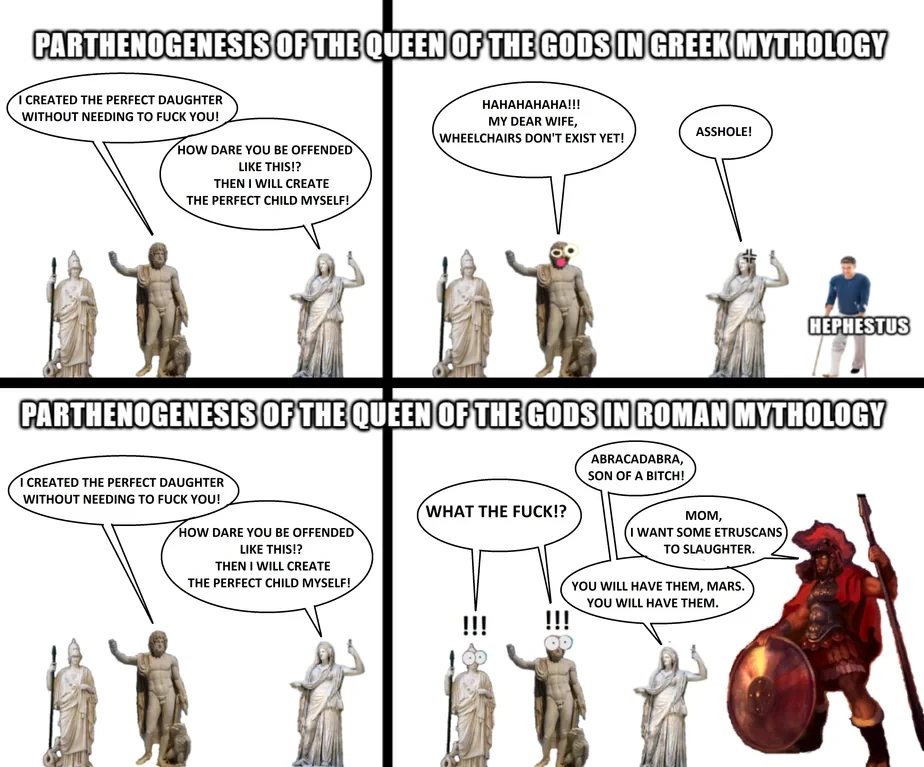
Explanation: Greek and Roman religion were very close - and for that matter, consciously merged as Greece became more integrated into the Roman polity. However, they were still very much not the same - the Romans had a number of core concepts and foundations that set them apart from the Greeks up to the latest points of Roman paganism.
While I could go on and on for... concerningly long about the differences, one of the big ones was mythology. Namely, the Romans didn't have much of it. For the Romans, the gods were the gods; wasn't that enough? When the Greeks told stories of the gods, the Romans accepted them readily enough - so long as they were in accordance with the Roman conception of those gods!
But one of the notable native myths the Romans did have concerned Jupiter (Zeus to the Greeks), king of the gods; his wife, Juno (Hera to the Greeks); and their children. The Romans accepted the myth that Minerva (Athena to the Greeks) was born of Jupiter alone, but not that Juno's response was to birth the disabled and thus 'imperfect' Vulcanus (Hephaestus to the Greeks). Rather, they suggested that Mars (Ares to the Greeks), as a god of war and nature (the latter not being part of Ares in the Greek pantheon), was born of Juno instead, with the assistance of a fertility flower. And Mars was one of the most revered gods to the Romans.
The Romans traditionally regarded family very highly, and while Juno was a WOMAN (probably has cooties 🤢), she was also a mother, and thus worthy of respect. The Romans, like many pre-modern peoples, were deeply misogynistic, but the concerns of family (and practicality) often overrode that. So for Juno to be humiliated, even by her husband, in birthing a child was an unacceptable break from the ironclad bonds of family valued by the Romans; instead, she, with the generative power of nature, creates the father of the Roman people, the god of war and protection (and again with the contrast, the Greek Ares being a god of war and destruction, a chaotic brute).
Amongst the Greeks, for example, it was common for a mother to pass into the power of her son after her husband died; he was the man, after all, and she only a woman. Amongst the Romans, however, it was the custom that a woman was independent and of her own household after the death of her husband (unless she chose to return to her father's household, if he was still alive). After all, who could imagine a CHILD having power over their PARENT!? Dogs and cats living together, the world turned upside down!
... also, since I can't resist, one other notable facet of Roman gods is that they were almost all also gods of war, including Juno. DON'T FUCK WITH MA
(another difference is that Vulcanus was often depicted as whole of body by the Romans, rather than disabled like Hephaestus)