"Sorry, I just hate populist dictators even more than I hate democracy, and I hate democracy a LOT"
16d 13h ago by piefed.social/u/PugJesus in roughromanmemes@piefed.social from media.piefed.social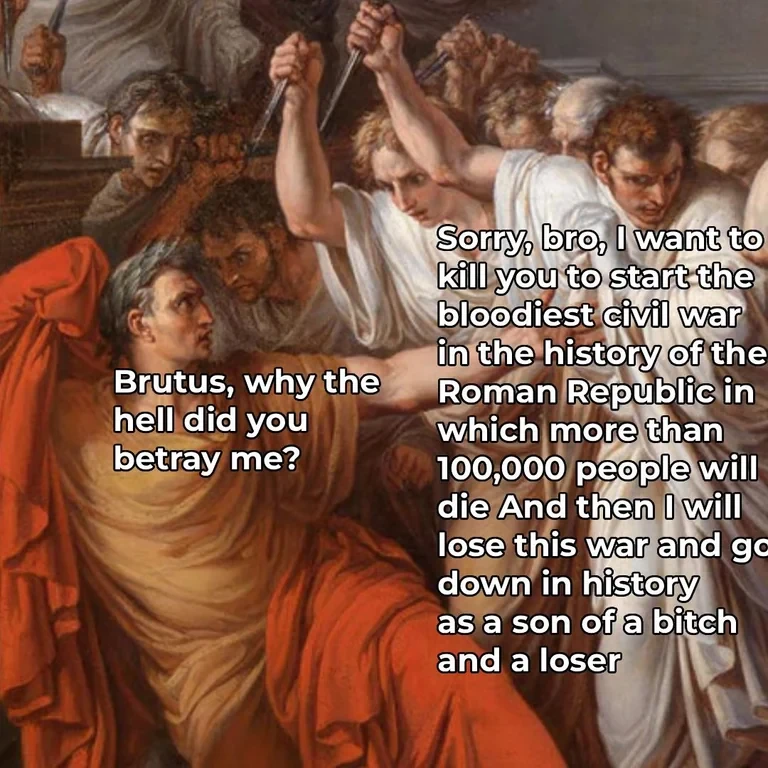
Explanation: PLEASE NOTE: I am something of a Caesarian partisan! While my view of Caesar is, I think, nuanced and certainly not uncritical, I am pretty unambiguously on his side in the whole conflict with the conservative faction! The below explanation is factually correct, but heavily biased against Caesar's assassins, so take it with a grain of salt!
Brutus, one of the prominent assassins of Julius Caesar, of conqueror and dictator fame, was probably an idealist. That is to say, he had ideals and believed in them, not that they were good ideals. Brutus was a longtime Optimate, one of the conservatives in support of the ultra-wealthy in Rome, while Caesar was a lifelong (if moderate) Populare. Despite the personal friendship between the two men - ideology in the Roman Republic only rarely preventing people from forming useful connections - when Caesar's civil war began, Brutus took the side of ideology, and fled Rome with the Optimates. All the same, like most of Caesar's enemies, Brutus was pardoned without preconditions once defeated, and Caesar continued to support Brutus's civilian political career - again, like many of Caesar's former enemies.
Caesar, of course, held a position of immense power in Rome, being able to 'sway' the Senate to appoint him dictator when he felt he 'needed' it, but this was a nonzero concession on his part - Caesar emphasized that he did not have the same interests as the ultraconservative dictator Sulla, whose memory many Optimates praised, who purged his ideological foes and political rivals when he took the dictatorship. Supporting his rivals' continued participation - and occasionally success, as Roman politics tended to be more personal than ideological - was still returning significant power to many men who had opposed him, signaling, at least nominally, that Caesar desired a return to a Republic wherein politics were resolved with words, rather than swords. How genuine that display was is up for interpretation. Brutus himself received Caesar's support for several major offices after the civil war.
At first, Brutus was encouraged by Caesar's pardon and position of power - enthusiastically writing to a fellow, if more moderate, Optimate, Cicero, that he had hope of swaying Caesar to the conservative cause (Caesar was excellent at making people hear what they wanted without offering anything concrete that could actually contradict him or be used against him; Cicero, who had more experience with that side of Caesar, wrote back saying the only way Caesar would become a 'better man', as the conservatives called themselves, was by hanging himself with a noose). As it became apparent that Caesar's lifelong Populare leanings were not, in fact, going to change now that he was the most powerful man in Rome, Brutus became disillusioned. Debt relief? Land redistribution? Jobs programs? O TEMPORA! O MORES!
So Brutus joined a conspiracy to assassinate Caesar before he left on his next great campaign. Brutus, particularly, insisted that several of Caesar's lieutenants not be targeted, because they had done nothing against the traditional order of the aristocracy. Like I said, he was an idealist, his ideals were just conservative dogshit. Caesar was successfully assassinated by a group of like-minded Senators. Many of the Senators were Optimates whom Caesar had fought against in the civil war and pardoned, but Caesar, by most accounts, was especially horrified when he saw Brutus amongst the knife-wielding conspirators, either saying "And you as well, my son?" in Greek, or wordlessly and weakly (as he had already been stabbed several times at this point) throwing his toga over his head, so he wouldn't have to see Brutus strike him.
Brutus, the idealist, announced to the Roman people the good news! The dictator had been killed! Rome was free!
Brutus's estimation of the mood of the Roman people was... off. The Roman people rioted. Caesar was the first successful Populare who hadn't been killed by the Optimates since the start of the ideological conflict ~80 years before... and after the assassination, Caesar no longer held that distinction. Many ordinary people remained skeptical of Caesar's long-term intentions, or disagreed with individual proposals and policies, but overwhelmingly, the people of Rome still loved Caesar as their flawed hero, who had finally managed some success against the Senatorial aristocracy's ever-tightening grip on power.
Brutus's estimation of Caesar's lieutenants, on the other hand, was correct - they followed Caesar out of personal loyalty and opportunism, not ideological dedication to the Populare cause or opposition to the traditional aristocracy of the Republic. Unfortunately for him, that did not make them his post-assassination allies. None of the Second Triumvirate ('rule of three men') who defeated the Optimate assassins were dedicated Populares, but all saw the great offense caused by Caesar's assassination as an excellent opportunity to seize more power for themselves at expense of the Senate, turning the 'neat' conservative coup 'restoring' power to the aristocracy into an incredibly bloody civil war.
Brutus would commit suicide shortly after his forces were defeated by Caesar's (ironically rather conservative) nephew and adopted-in-his-will son, Octavian (later known as Augustus); and Caesar's chief lieutenant at the time of his death, Mark Antony (who had no ideology at all, but personally admired Brutus as a fellow aristocrat possessed of great personal bravery and determination).