30 seconds in
2d 11h ago by piefed.social/u/perishthethought in microblogmemes from media.piefed.social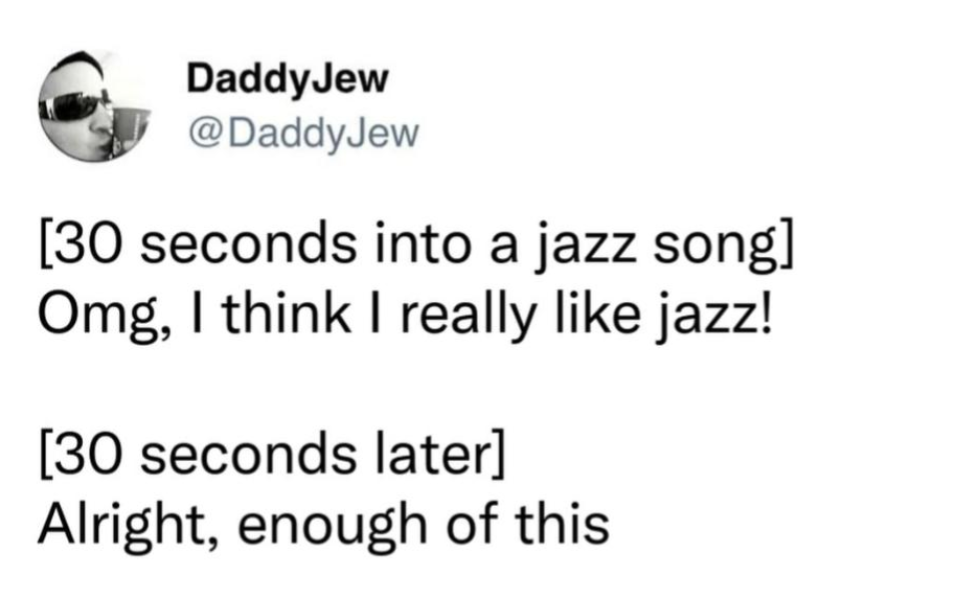
I kid but also listen to jazz every day.
Join us at !jazz@lemmy.world if you dig.
So, what you are saying is, I need to make a jazz band that does 30 second songs.
Punk jazz
Grindcore jazz!

All music is made better by adding blast beats!
https://open.spotify.com/album/0iOm24AgSS0FINNnITElWe
Subnormal Dives by ByoNoiseGenerator is a deathgrind jazz fusion album.
Not quite 30 seconds songs, but the longest song is 3:25 and most average around 2 minutes-ish.
Like the Messthetics
https://dischord.com/band/messthetics
Fugazi + jazz? Fuck yes!
A jizz band
Jizz is already a musical style, its what those aliens play in the cantana in star wars.
That'll be John Zorn's band Naked City. Try their album Torture Garden, featuring such tunes as Jazz Snob Eat Shit
So jazz for the TikTok...
Sounds like it can be up to 59 seconds long and still work.
"It's like, we get it, you can blow a trumpet. Wrap it up, Elton John!"
Oh yes, Elton John, famous trumpet jazzy.
(Love the good place, just watched that episode)
Smooth Jazz yes, but when there’s improvisation I tend to nope right out. Smooth jazz, big band, ragtime - all play the same way each time but for different focus (like big band/swing is for dance).
The only time I’ll tolerate improvisation jazz is while eating dinner when it’s socially acceptable to ignore the music and leave when done eating.
Improvisation can be really good when you get someone talented who's actually applying music theory (many jazz musicians do this).
But when you get avant-garde, the whole point is basically about throwing music theory out the window. It's supposed to be radical/deconstructionist/post-modern, but personally I think it sounds like crap.
Some people think I'm being snooty when I say this, but it sounds like dadaism on a saxophone. Some people claim to like it that way, but I'm pretty certain they're just saying that to be edgy.
Philosophically, it's the jazz equivalent of noise metal.
People listen to music for different reasons. Sometimes it's to be entertained, sometimes it's to experience something else.
If you really understand music theory, you'll see that it's a science, with math at its core. The art is in how the science is applied.
If a painter forgets the color wheel, they won't be able to mix colors to get what they want. They'll wind up with a bunch of browns when they wanted greens and purples. If they forget the fundamentals like lines and forms and negative space, they'll end up with shapeless blobs.
I mean I guess some people like abstract art, and that's fine. But let's not pretend music theory is just some relic of colonialism. It isn't eurocentric to believe harmonious and rhythmic music sounds better than music that isn't.
The art is in how the science is applied.
No, the art is how you express yourself. The theory is just "the way most people in a culture do it because other people in this culture like it". There is certainly some biological reasoning behind it that is common across cultures, but it's a fairly small part of music theory. Consider a simple question like "why are dissonant chords considered dissonant?" and it can lead you down a path of discovery.
It isn’t eurocentric to believe harmonious and rhythmic music sounds better than music that isn’t.
It absolutely is eurocentric to enforce western music theory as some holy book that separates good music from bad music. It's a tool that helps you write music that sounds good to a western ear. But a lot of good music can disagree or break the norms of western music theory.
No, the art is how you express yourself.
That's not a disagreement with my statement that "the art is in how the science is applied."
People expressing themselves are applying the science, whether they're doing it consciously or not.
The theory is just "the way most people in a culture do it because other people in this culture like it".
Music theory isn't about preference. It's about "place tension on a string at intervals of halves and thirds, and it creates a harmonic resonance." Or "two resonances with specific vibrational proportions relative to each other create certain effects."
There is certainly some biological reasoning behind it that is common across cultures, but it's a fairly small part of music theory.
It's not biological, what the fuck? It's geometric, primarily.
Consider a simple question like "why are dissonant chords considered dissonant?" and it can lead you down a path of discovery.
Dissonance is the effect produced by two or more resonant frequencies whose proportions to each other aren't fractional, or aren't simple fractions.
Ask yourself why harmonious chords are all at set intervals. To keep things simple, let's consider one musical scale. Why do you think 1-3-5 forms the basis of every chord progression? Why do you think 1-3-5-7 produces a similar effect across any musical scale? Why do you think sus2, sus4, diminished, and augmented chords produce consistent effects no matter what scale they're applied to?
Granted, I recognize that these are examples from western notation, but the concept isn't limited to western notation. If you break the whole steps and half steps into microtonals, you can "convert" a western musical scale into any other culture's system, and vice versa. Just like converting between fahrenheit and celsius.
It absolutely is eurocentric to enforce western music theory as some holy book that separates good music from bad music.
I'm not enforcing "western music theory" as anything! That's a leap you're making, by conflating "music theory" with "western notation." In other words, you're the one being eurocentric.
Also, I made no statements on what separates "good music from bad music." That's about preference, which is in the art. It's wholly outside the realm of the science that underlies the art.
It's a tool that helps you write music that sounds good to a western ear. But a lot of good music can disagree or break the norms of western music theory.
The "western ear" is a false construct. There's all sorts of people in the west with ears for all sorts of different music. There isn't some unified "this sounds good to westerners." That's ridiculous. What you're doing is attempting to conflate the art of music with the science of music, to claim that there is no science. There is a science, it just has nothing to do with preference. Preference is entirely within the realm of the art, which applies the science, and can do so in many ways with much variance.
Different people like different kinds of cars. Different cultures make different cars. But would you really try to argue that the science underlying mechanical design doesn't really exist because people have different preferences in the way that science is applied?
No one would say "Red and blue make purple" is a western colonialist or eurocentric statement. Color theory is a science. Visual arts apply the underlying science to create variance of expression, and everyone has their own preferences regarding that expression. But that doesn't change the fact that the color wheel is a science. Lines and forms are a science. Light and shading is a science. They can be applied in abstract ways, and people can like or dislike them, but it's still a science.
Likewise, rhythm, meter, and harmony are sciences. They can be applied in different ways. They can even be described in different ways. But underlying them are certain mathematical constants, and if you don't understand that then you're revealing your ignorance about musical theory.
Hey you're fighting the good fight with your really great replies to the ignorant replies you're getting, more power to you.
I've seen some dumb takes on Lemmy but "science of music theory is western eurocentric colonialism" is a new low bar.
“science of music theory is western eurocentric colonialism” is a new low bar.
It is literally the core principle of modern ethnographic musicology. 50 years ago there were people claiming that eastern microtonality was a savage aberration.
You're continuing to conflate "music theory" with "western notation."
Music theory itself is far more expansive than that, and the fact that you're pretending that only western notation counts as music theory is extremely problematic, and also the source of the disconnect.
Music theory has a history, and you seem to be completely ignorant of it.
There are multiple histories of various musical systems which are encompassed by music theory.
If you want to exclude every non-western musical system from "the history of musical theory" and define "music theory" as exclusively pertaining to western-style notation, then that's a really shitty and eurocentric outlook, and that's on you.
It feels exactly like arguing with climate change deniers 🙄 they don't understand the science so they just pretend the science doesn't exist and it all comes down to subjective interpretation.
There is subjective interpretation in music, but that falls within the realm of art, which I even acknowledged.
They're conflating the art with the science, and using that to claim that there is no science underlying the art. It's absurd at its core.
This is honestly unrelated to my point but I'll entertain it anyways.
But let's not pretend music theory is just some relic of colonialism.
We don't have to pretend tho.
https://youtu.be/Kr3quGh7pJA
Jazz borrows from western music theory but has its OWN theory.
It isn't eurocentric to believe harmonious and rhythmic music sounds better than music that isn't.
Are you proposing experimental jazz doesn't have rhythm and harmony?
Music absolutely doesn't need to have western rhythm and harmony to be enjoyable.
Oh, somebody made a youtube video claiming music theory is white supremacy. Might as well be peer-reviewed research then! /s
Jazz borrows from western music theory but has its OWN theory.
It has its own what? Theory? What kind of theory is that? Oh, music theory! Wow. So what you're saying is, jazz has music theory.
That was a lot of hoops to jump through only to end up not disclaiming anything I said.
Did I ever say "Western music theory is the only valid system of musical notation?" No, I said "music theory is a science." And it is. You conflating "music theory" with "western musical notation" doesn't change that.
Go read about John Coltrane's circle of fifths. If there wasn't a science underpinning music theory, it simply wouldn't work. The reason it does work is because there are geometric proportions underlying musical phenomena.
Are you proposing experimental jazz doesn't have rhythm and harmony?
I never said that. But if you're talking specifically about avant-garde, the underlying philosophy of which is specifically and explicitly stated as deconstructing systematized musical conventions (including rhythm and harmony), then I'd say yes, the entire point of avant-garde is to be arhythmic and anharmonious.
Music absolutely doesn't need to have western rhythm and harmony to be enjoyable.
You're fucking adding all these layers of "western" this and that, which are things I didn't say. I said music theory isn't eurocentric, because it's more expansive than just western notation. You're the one operating on the assumption that only western notation classifies as music theory.
If you honestly believe that "rhythm" and "harmony" are exclusively western concepts, then you're extremely ignorant and eurocentric, and you need more exposure to international music.
Whether you wanna talk about Western or Byzantine or Arabian or African or Indian or Chinese or Native American musical systems, or any other kind, all of these systems of music utilize rhythm, meter, and harmony. They have different ways of using them, different ways of annotating them, and different ways of incrementing them, but they all use them.
The concepts of deconstructing musical conventions, such as is seen in avant-garde, dadaism, and noise metal, have only arisen in the 20th century and forward. And guess what. They arose primarily in the west! By western musicians. So there's nothing "colonialist" about a philosophical rebuttal of those concepts.
So your misinformed takes reveal not only your ignorance of musical theory and of international musical systems, but also your ignorance of musical history.
Edit:
P.S., if you didn't pick up on how a critique of avante-garde relates (or doesn't relate, as I'm claiming) to anti-colonialism, then you clearly don't have a very solid understanding of the history and philosophy underlying avant-garde. From it's inception, it was framed as an anti-colonialist deconstruction in the post-modern movement.
My argument is solely this: that's it's entirely possible to be anti-colonialist without rejecting music theory as a whole. Because music theory isn't limited to just western notation.
Everything else you're arguing against is purely strawman and red herring.
If this is meant as a reply to my comment I gotta say, this is an incredibly shit take.
I think you are replying to the wrong thread or something maybe?
My bad, I got you mixed up with someone else I was arguing with in this thread. They got my panties all in a bunch and the blood to my head.
On a glance back over the exchange with you, yeah my response was way overblown. I was just getting fed up with arguing with a dense user and my patience had worn extremely thin. I apologize for letting that blow up on you.
I'm gonna straight up disagree here. All your points are mislead. There's math in music, but music isn't just math.
A quick example. If you listen to contemporary GenZ music, you'll notice a ton of extremely happy songs, that are in minor scales. This usually trips classically trained musicians because, well, major = happy, minor = sad, was the science for the past 400 years. However, this is not a natural imperative, it was a cultural quirk of western musical tradition. Contemporary pop, is doing away with it as younger composers and producers experiment with modal theory and unorthodox rhythmical structures and find wild commercial success with younger audiences.
Then you have some young bands like Angine de Poitrine (of recent viral fame), that just flips over your arguments by making microtonal polyrithmic music that is perfectly scientific and mathematically organized yet it sounds alien. Music is art, get over it. If people likes it, science has no power over it. Music theory is, precisely, just some relic of colonialism.
There's math in music, but music isn't just math.
I didn't say it was just math. I said the art is in applying the science. And that holds through all of your arguments.
you'll notice a ton of extremely happy songs, that are in minor scales. This usually trips classically trained musicians because, well, major = happy, minor = sad, was the science for the past 400 years
No, the mood is in the application. That's part of the art. The science is in how many microtonals are between notes on a scale. In western musical systems thats 12-12-6 (whole step - whole step - half step). There are other musical systems, but the science is still underlying.
Contemporary pop, is doing away with it as younger composers and producers experiment with modal theory and unorthodox rhythmical structures and find wild commercial success with younger audiences.
Again, that experimentation is in the application. That's the art. The concepts they're experimenting with: modal theory and rhythmic structures (whether orthodox or unorthodox) are the science. They can be described numerically. All the qualia which result from their application are the art aspect, but the building blocks of those qualia are quantitative and precise.
that just flips over your arguments by making microtonal polyrithmic music that is perfectly scientific and mathematically organized yet it sounds alien
The "alien" sound is the qualia; that's an aspect of the application. In other words, the art. The microtonals and polyrhythmics are fundamentally mathematical, and thus a science.
There's a lot you can do with baking. Even unconventional. But to deny that baking is science at its core, and an art in its application, would be wildly ignorant.
Music is art, get over it.
I never said it fucking wasn't, but there is a science underlying it. Get over it.
If people likes it, science has no power over it. Music theory is, precisely, just some relic of colonialism.
Some people like flat earth theory and being unvaccinated, are you saying science has no power over that?
Yes, people can like unconventional music. I never said they can't. Convention itself is about application. Unconventional implies something about the art, or the application of the science. That doesn't change anything about the underlying science.
Music theory is, precisely, just some relic of colonialism.
That's a wildly ignorant statement, since many cultures have their own musical systems. Music theory isn't just western notation, and if that's how you're thinking of it then you're the one with the colonized mindset.
By quantitatively analyzing microtonals, rhythm, meter, and tempo, a musical work from any musical system can be understood by its fundamentals. This says nothing about the art or the expression or the qualia or people's preferences, because those are all aspects of the application of those fundamentals. But that doesn't change the fact that the fundamentals themselves are intrinsically mathematical and scientific.
Wow, so many words to say so little. Jazzists forgot nothing, if anything they are usually the most classically trained musicians you can find. It bears nothing with your asinine tangent. Just like in art, avant garde jazz musicians and dadaist painters were usually the technical cream of the crop of their fields. If it is a matter of taste, leave it at that. But it has nothing to do with knowing music theory and prescriptivist notions of what music is or ought to be.
Just because you didn't understand anything that I said doesn't mean I said little.
Jazzists forgot nothing, if anything they are usually the most classically trained musicians you can find.
I never claimed otherwise. But if you don't understand what avant-garde is, just say so. Because you're honestly embarrassing yourself at this point.
It bears nothing with your asinine tangent.
- It's not a tangent, it cuts straight to the core of what this argument is about.
- Just because you don't understand it doesn't make it asinine.
Just like in art, avant garde jazz musicians and dadaist painters were usually the cream of the crop of their fields. If it is a matter of taste, leave it at that.
I'm not arguing about taste. People can like avant-garde if they wish. They can like dadaism, sure. You can go see Yoko Ono live in concert, I'm not stopping you.
But what you don't seem to understand is that there is a philosophical movement underpinning both avant-garde and dadaism. That philosophy is the deconstructionism of post-modernism. And it made the claim that because western musical notation originated in the west, that it's associated with colonialism, and therefore an anti-colonialist movement should reject western-style music.
The error in that reasoning is, as I've pointed out multiple times, that "music theory" ≠ "western musical notation". And you can continue digging in your heels while trying to conflate the two, but it doesn't make you any less wrong.
But it has nothing to do with knowing music theory and prepcistivist notions of what music is or ought to be.
Dadaism and avant-garde were specifically about rejecting systematized conventions which were common in western styles of music. In order to reject something, you need to know what you're rejecting. So no, it doesn't "have nothing to do with knowing music theory." Knowing music theory is at the core of the argument we're having.
Also, music theory isn't prescriptive. Nowhere in music theory is there a claim that "this is what 'good music' is, and this is what 'bad music' is." That's a fucking caricature detached from reality. It's closer to musical critique.
Music theory is descriptive, and the fact that you don't understand that makes it abundantly clear that you don't know anything about it. You're literally pulling a dunning-kruger.
Since you are so adamant of quoting like a madman, let me show you how it is done.
But what you don’t seem to understand is that there is a philosophical movement underpinning both avant-garde and dadaism. That philosophy is the deconstructionism of post-modernism. And it made the claim that because western musical notation originated in the west, that it’s associated with colonialism, and therefore an anti-colonialist movement should reject western-style music.
Glad to see you agree with me that your original comment was out of place. Let's leave it at that. Also, extremely prejudiced of you to assume what I know or don't know. Peak internet bad faith arguing.
It isn’t eurocentric to believe harmonious and rhythmic music sounds better than music that isn’t.
But it is. You just said so yourself. That's the whole point of dadaism and avant garde, as you so eloquently exposed.
personally I think it sounds like crap.
It is a matter of taste, you don't like it, fine. Shut up and let's move on. It has nothing to do with following or not following musical science, whatever it is that you personally conceive as such. As you pointed out, musical theory is just describing what musicians, artists, are doing. Just because you don't like it doesn't demerit its value. Bunch of great painters have come up with marvelous, brown only, paintings. that are not inferior just because you feel like they don't know anything about color theory. I suspect there's someone else in this thread with worrying notions about what has value and what doesn't, and it ain't me.
Glad to see you agree with me that your original comment was out of place.
I don't agree with you, and it wasn't out of place. You're still distorting my arguments because you can't admit that you were wrong.
Also, extremely prejudiced of you to assume what I know or don't know. Peak internet bad faith arguing.
I'm not assuming anything. You made your ignorance clear with your statements.
It isn’t eurocentric to believe harmonious and rhythmic music sounds better than music that isn’t.
But it is. You just said so yourself. That's the whole point of dadaism and avant garde, as you so eloquently exposed.
No. Unless you're still trying to conflate music theory (including rhythm and harmony) with western musical notation. Which I've told you repeatedly are not the same thing.
Rhythm and harmony exist in musical systems outside of the west. And the fact that you can't seem to get that through your head is what's eurocentric.
I told you the philosophical underpinnings of avante-garde and dadaism. I also mentioned why it's erroneous to equate "harmonious" with "western". What part of that are you not getting?
personally I think it sounds like crap.
It is a matter of taste, you don't like it, fine. Shut up and let's move on.
My personal opinion, which I explicitly tagged as "personally I think"? Yeah, you're right, that is a matter of taste. I can express my tastes. And that can still be completely separate from the argument that "music theory is fundamentally mathematical and descriptive at its core, making it a science."
Two different statements, and only one of them has any bearing on my personal taste. And I made that separation pretty clear.
It has nothing to do with following or not following musical science, whatever it is that you personally conceive as such.
- Someone's personal tastes may or may not have anything to do with the musicality of the music. I just happen to prefer music with fine degree of musicality.
- The science underpinning musical theory has nothing to do with my personal tastes or conceptions. It's objective. And I'm getting sick of you not being able to get that through your thick skull.
As you pointed out, musical theory is just describing what musicians, artists, are doing.
I never said that. That sounds more like musical critique.
I said music theory is descriptive, but it doesn't describe individual musicians. It describes the basic components and building blocks of music (i.e., tonality, harmony, rhythm, tempo, meter, etc.). Inasmuch as those fundamental building blocks are inherently mathematical (which if you don't understand, it's your ignorance), music theory is a science.
Just because you keep trying to conflate the science of music theory with the art of musical expression, does not mean the science underpinning the art doesn't exist. It just means you don't understand it.
Just because you don't like it doesn't demerit its value.
It's not about what I like and don't like. What the fuck, we're arguing in circles. Are you a troll?
Bunch of great painters have come up with marvelous, brown only, paintings. that are not inferior just because you feel like they don't know anything about color theory.
Just because a painter can make a good painting that's entirely brown, doesn't disprove the fact that there's a science behind what colors mix to create what colors. You can't mix red and green to get orange just because you feel like it. If you want brown, you mix colors that make brown. If you want orange, you mix colors that make orange. And now matter how badly you torture my arguments to make them sound ludicrous, that only proves that the point is going way over your head.
I never said "an all-brown painting is inferior." That's more assumptions that you're projecting onto me. I said if you want to mix colors to get the colors that you want, you need to understand the color wheel. Because there's a science behind it.
I never made any statements whatsoever on what art has "value" and what doesn't. You keep loading up all these terms with meanings that I never implied. You're full of straw men and red herrings, and you're the one not arguing in good faith. You've never actually refuted a single point that I've made, only misrepresented them to try to score easy points.
What a dense brick of elitism. You speak so much that you stopped noticing when you contradict yourself. It is also rich when you accuse others of ignorance or misreading, when you don't even understand what your own words mean.
I thought it sounded poorly at first, but when I took a class from an experienced Jazz improvisation instructor I was able to build a deeper appreciation for the sound.
I personally feel it’s something that can grow on you the more you try to connect with what idea or emotions the musician may be trying to convey. Especially since that’s what the musicians are trying to do when picking up on each other’s signals while playing.
If they're able to "pick up on other's styles while playing" then they understand music theory enough to do that.
That falls under "improvisation while understanding musical theory."
My criticism of avant-garde was different, not directed as a blanket statement about all jazz improvisation.
For avant-garde there are some stylistic elements you can pick up on such as a sense of things falling apart or even distress based on the way something is being played. The other musicians may add their own ‘voice’ in on the story good or bad.
It can still be a compelling story being conveyed but it’s not necessarily something you’d put on when you’re intending to relax.
To each their own.
I think of more avant garde stuff as a whole different category: like you're tired of just listening to good music and now you want something weird and interesting that may fail but definitely tried.
You know like a rough indie video game or movie that might not be the most fun but tries to communicate something (to varying degrees of success).
Edit omg reading on, this thread turned into a whole thing. Music people...
Yeah, I mean it's perfectly valid if you want to listen to avant-garde. No one's stopping you.
My whole point is that the whole point of avante-garde is to reject musical conventions. That's not an opinion, it's literally what avant-garde is.
There's a philosophical argument to be had about what defines music, and how does it differ from noise or sound?
Some people might say dadaism counts as music, others might say it doesn't. And that depends on your definition of music.
I'd put it this way:
Does an audio recording of a construction site count as music? Or is it just noise?
Mind you, one can edit the recording and rearrange it into something musical. However, doing this would require an understanding of rhythm, tempo, meter, pitch, harmony, etc. These are the fundamentals of music theory which I describe as a science because they're mathematics at their core, purely quantitative and descriptive.
They tell you nothing about how to use those concepts together to create "good music." They simply define the components of music itself. How they're arranged is up to the artist, and that whole range of expression is the art side of music.
One could argue that music doesn't need to be melodious or harmonic or rhythmic or any of that. But if that's the case, then how is it different from noise? Does that make the unedited construction site audio "music"?
I would argue that but I have a very broad interpretation of music and art in general and don't actually care that much about categories.
I mean that's valid, I'm not claiming that music has to be defined a particular way, even though if I were personally to define it I would probably include certain characteristics that distinguish it from noise. But I'm not claiming my personal definition is the only valid one.
The whole point of philosophy is to dig into ideas a little further than we ordinarily do. People can have different opinions, and that can stimulate good discussion. At least, as long as people don't resort to bad-faith argumentation by misrepresenting someone else's argument or taking other cheap shots like that.
What I mean is, although you say you don't care about categories, do you consider the sound of a construction site to be music? If so, that's fine, and I'm curious what your definition of music is. And if not, then I'm curious how you distinguish between noise and music. Is there any defining characteristic that places a collection of sounds squarely in one camp or the other, or is it entirely ambiguous?
I suggest giving Keith Jarrett's Koln concert a listen.
It's the first piece of jazz I've ever been able to sit down and listen to from start to finish.
Sounds about right.
Improvisational jazz: "bro it's been 84 measures of discordant shit, just resolve the damn thing already and play the root of the chord!"
edit:
Roses are red, violets are blue, some people have autism doodliotoodat mmbat goodatgooctmapanda macamapandiddle patmaksboodliodoo dimpaoacmapaway choopamadampakampa shittlybittly gampapawakombucha shoodleeooowasasaampandaweeeeeeeeeeeeeeeeeeeeeeeeeeeeeeeeee dittlyittlybimbopadooooo oooooo oooooOoooooooOooOOoOOooooo chamimbamamdapaweeeee
Smooth jazz is better 🖕
"You just ain't never had it done right."
Old musician's joke "Do it once, it's a mistake; do it twice, it's jazz."
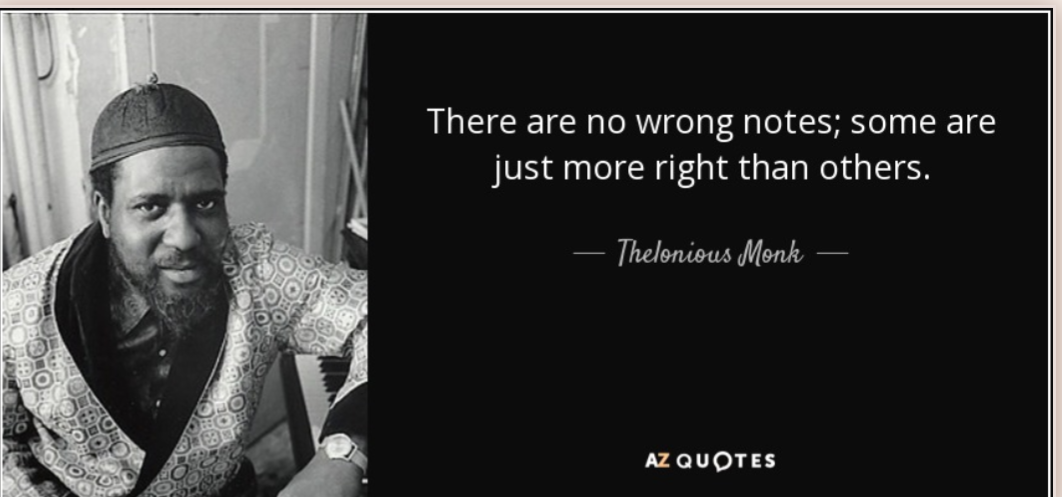
This poster jazzes.
"Repetition legitimises"
This happened to me the first time I listened to BADBADNOTGOOD.
Got through most of an album and thought "whoah, I've been listening to jazz for ages".
Tried some other jazz and thought "Hmm, maybe not"
I'm no expert, but I think badbadnotgood is jazz fusion so that makes sense.
And keep looking for jazz you might like. It grows on some of us, over time.
Absolutely, I'm constantly on the lookout for new music. While the music I listened to as a teen had definetly ingrained in me my tastes I have noticed there's a time and a place for most music.
The thing is, there are many kinds of jazz.
Smooth jazz? Cool.
Cool jazz? Sweet.
Progressive jazz? Alright!
Avant-garde? Err...
"Jazz isn't dead. It just smells weird. "
~ Frank Zappa
Jazz gives you 30 seconds of “I get it” followed immediately by where is this song going and why am I being chased?
If my mind wanders away from it then back, I lose track and get annoyed, but it's likely because I wasn't paying attention and lost the plot a bit.
Jazz speaks in a way. If you drift from it a bit, you lose the conversation.
I think folks are just listening to the wrong jazz!
Here's a few modern jazz or jazz fusion song recommendations from me worth checking out:
'Ramen! Yes!', 'XYZ', and 'Balloon Pop' by Hiromi's Sonicwonder (also credited separately as Hiromi and Sonicwonder)
'Desire', 'Knowledge', 'Prologue', and 'Fists of Fury' by Kamasi Washington
and it's bossa nova which I guess is technically samba not jazz, but I say close enough to still recommend 'I Took the L' by John Roseboro
Bonus recommendation if you're open to heavy music (this is death metal jazz fusion!):
'Eb (D#)', 'IQ69Exaltations,' and 'deBroglieNeverExisted' by ByoNoiseGenerator
Joined! Love jazz. Been trying to learn jazz guitar for the last 10 years. In phases, granted. This time around I’ve stopped caring about scales and have embraced voice leading and chromaticity. Finally starting to get it, I think. Also, there’s this amazing channel on YT: things i learned from barry harris
Oh! Guitar is my second fave instrument. I'm no player but I dig Charlie Christian and Johnny Smith the most. Check them out if you've not come across them yet.
All yall need some Hiromi in your lives. Also some Snarky Puppy
7 1/2 minutes into that Snarky Puppy, all are one in the celebration of the groove. Brilliant!
Just gotta find the right drummer
Buddy Rich - Nuttville
https://youtu.be/XDLAxkZ-lLs
Nice one, though I prefer Philly Joe or Kenny Clark, but they're from a different era.
Listening to some Medeski, Martin, Wood right now
Putting their "Out Loader" into my queue for tonight. Great idea.
Every genera has a really really great few moments but those are only temporary and you are left only with a yearning for more and depression.
Listening to a group just jamming in any genre is boring. Selecting the best parts and composing them into to a refined piece of music with a lot of deliberate thought behind it goes a long way towards creating something worthy of a listener’s time.
Oh man, I agree that sometimes jam sessions are boring, but I've heard many that are not.
You do you, but for me, some jams are just sublime, the longer the better in those cases.
For example -https://youtu.be/kAUs187IT4I
Norman Granz' Jam Session #2 (1953)
Alto Saxophone – Benny Carter, Charlie Parker, Johnny Hodges
Bass – Ray Brown
Drums – J.C. Heard
Guitar – Barney Kessel
Piano – Oscar Peterson
Tenor Saxophone – Ben Webster, Flip Phillips
Trumpet – Charlie Shavers
Real improv, real gone, man! :)
You’ve never been to a bluegrass jam, then. That’s a party, and there’re plenty of songs to go along with the tunes, too. The solos are short and go off, and then you’re back at it. A song or tune only lasts so long and there’s always movement to keep it alive(which is why I didn’t say old time fiddle music since it’s also very repetitive).
Jazz jams, as someone who swing dances, are generally incredibly meh. The core audience take themselves too seriously to create a fun atmosphere, and the solos all last waaay to long. They play for themselves, often to the point where even the band is disconnected from itself. My friend once played a recording of her friends at a jam for us to practice to and it was so bad that they weren’t even in time with eachother.
Go to your local bluegrass jam and relax. Playing music with others is really important.
Like Classical, Jazz is not a casual musical language. It requires extensive knowledge by both the artist and the listener.
Edit: Getting some resistanc, which is more than fair. I was a bit flippant with this answer. Like most genres of music, when someone mentions it, people think of the style that they know most.
For me, jazz is best represented by BeBop, which MANY people are imagining when they think of dense, non-melodic jazz that they hate, and that's what I was thinking of. To understand Bop, it really, really helps to understand the underlying music theory. Bird and Diz and Miles and Trane were doing some amazing things, that become even more amazing when you know the theory.
OTOH, if the mention of jazz calls up Big Band music, or the Smooth Jazz of the 90s, you wouldn't need any more musical knowledge to enjoy those, any more than any other more popular music.
Those genres are legitimate jazz as well, as are others, and I am actually a huge Big Band fan, so I shouldn't have been so dismissive.
Hard disagree. It's like anything else: people like what they like.
I don't know fucking shit about fuck and I still enjoy jazz longer than 30 seconds.
People listen to jazz for the same reason people start smoking. Because, it's cool, not because it's fun.
Hmmm, are you projecting or ...?
That is just not true for a lot of us. And, IMO, generalizations like that don't really help move conversations forward.
Yeah wtf. Smoking is super fun.
I mean not immediately it isn't
What's with the down votes? You didn't say jazz isn't fun.