Obvious choice
14d 5h ago by lemmy.dbzer0.com/u/Viking_Hippie in solarpunk@slrpnk.net from slrpnk.net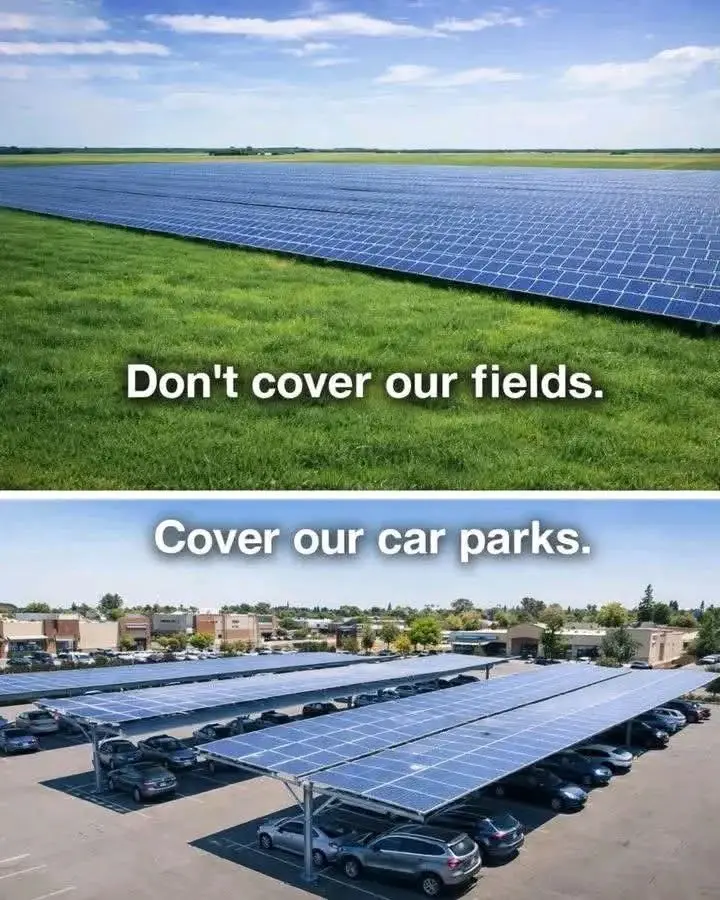
False dilemma.
Also that ain't no field.
Crop yields are only very slightly affected by agrivoltaics and variance tends to be reduced. Water usage is reduced a lot.
Even dedicated agrivoltaics would only cover a fraction of usually sub standard land for giant power outputs. The fear of someone plastering the environment with solar is fear mongering.
Building enough parking infrastructure to cover with panels is a waste of space (outside of America).
It's probably a good idea to put solar panels on car parks where we're going to have car parks anyway, though. In addition to agrivoltaics and using, as you say, substandard land for large scale solar. Also put it on roofs. Basically anywhere it doesn't do any harm, I say.
Governments should encourage every home to have at least enough solar powered energy to run a small refrigerator, a space heater, a small cooking surface, and a radio as a matter of national security. That can be achieved with porch solar and significantly hardens a population against attacks on energy infrastructure.
Would also require an isolation switch to be effective. With a grid-tied solar install it's going to dump all of the energy into the grid, and during a power outage that energy will simply not be collected.
I could see that becoming a thing where during a power outage you flip a switch near the electrical panel and then every green-colored outlet will run entirely off the solar panels when the sunlight is available. Or if we really want to make it technical solution, create special outlets that are dual power (grid and direct from solar) and then appliances plugged into these special outlets will switch between power sources as they're available. Potentially some issues with two different AC circuits touching depending on how it's implemented on the appliance side, but it could be a good solution especially if the controller can still backfeed excess energy production back into the grid
We already have hybrid inverters that does that automatically, you don't even need a different circuit or special outlets. It can manage all the grid ties, off grid and battery parameters on the fly
Well shit that's awesome! Like I'm kinda curious how it handles the load exceeding capacity, but I suppose if you just turn everything off that should probably be fine
how it handles the load exceeding capacity
As in what happens if you plug too much stuff that it exceeds your solar production?
I'll use mine as an example, but it might be different with different models and configurations:
Inverter can handle up to 10kw
If solar production is at 5kw, and home is demanding 7kw, in my case, I have it set up as to draw the remaining 2kw from the battery, if battery is depleted, it will draw 2kw from the utility company
If home demands more than 10kw that the inverter can handle, it will trip the internal inverter protection or a circuit breaker leading to it
You don't need that switch. There are already automatic switches. And if you have batteries you can load them from the panels and, in case they go too low, from the grid and then use the batteries to power your house.
I want to do something like that but just have the solar circuits entirely disconnected from the grid, running stuff like fridge, freezer, water heater, car charger, etc (depends how many watts my panels can actually manage in practice; I don't have a ton of space). all without being able to draw from the grid at all.
My state is pretty shitty about solar, and I don't particularity want to give the electric company my surplus power for free for them to turn around and profit from, so fuck ‘em, ill figure out how to perfectly balance my use with my capacity and just save the spend.
With the current prices of panels you might install a few more than needed.
That's so fucked up. Even people who install solar have to give free energy to the utility company, who probably still charge them for energy...
Yes, thats exactly what they do. No net metering, no discounts or rebates, nothing, but if your power flows back into the grid, they sure will charge for it at the exact same rate as if they created it themselves, and charge you as much as they can get away with to eat into your savings (some utilities around here even make you pay a monthly fee to have your own solar on “their” grid..). No surprise hardly anyone here has solar; it’s generally not worth having unless you can guarantee you use all of the power yourself.
My locality is mostly hydro power, we don't even really have peak/off-peak rates, just pay the same all the time regardless because they can’t easily adapt to demand anyway. And like yay renewables and stuff, I'm super on board with that aspect, but I'm not on board with having a monopoly on the renewables, since my area is not typical of the state.
That's absurd. People should use repurposed EV batteries and just power their homes on solar without connecting to the grid. I get that it's probably a legal requirement to connect your solar to the grid, but that's bullshit and nothing short of state-sanctioned theft.
Exactly why basically that is my goal :)
I’m technically too urban to be entirely off-grid, legally, but I see no reason I can’t minimize my draw with a separate breaker system. Whole place needs to be rewired anyway because it’s ancient. Knot and tube ancient.
But most people aren't willing to go through that, and I cant blame them because there aren't any incentives to doing so, and most people don't realize how much cheaper used solar farm panels are, so it just seems like a really bad deal. And for most, who would have it installed for them, new, maybe thats true. Used with mostly-self-install is much cheaper. Even better if the whole deal needs to be re-wired anyway.
Except most solar systems go down without power from the grid
I would say let’s maybe not have car parks at all? They suck. We should as a species try to phase out personal cars, first of all. And secondly, until then, underground garages are infinitely better for everyone else.
OK, so in 100 years you get your wish and personal cars no longer exist. For the next 100 years, would you like to:
- put solar panels on top of car parks; or
- not do that?
In addition, after 100 years on top of the car parks that still exist (perhaps for the shared cars), would you like to:
- have solar panels on top of them; or
- not have them?
How about we get that wish in, say, 10 or 20 years instead of your strawman scenario? Transforming cities to be walkable/bikable does not take that long, if you're serious about it.
Personal cars are going to be here for way longer than 20 years, but 20 years is still long enough to build a lot of solar panels, so the same questions still arise. What will your answer be?
Tops of buildings, over canals, may be even over roads and rail.
It isn't that far out of reach that a car park gets covered in solar panels, then the next developer reuses them when redeveloping the site for denser development.
You forget that people live also outside of cities. If you live in a town away from any city you need a car.
No I didn't. First of all, forgetting and disregarding aren't the same thing.
Second, living in a small town isn't an excuse. Small towns are inherently walkable (due to being, ya know, small) unless you somehow manage to design them spectacularly wrong. And contrary to American belief, it is actually possible to provide rail transit to them: the US itself used to do it 100 years ago, and Japan still does.
In Spain, where I live, there are town (<1500 people) that have the closest supermarket art 25 km of they are lucky. And no bus or 2 in the day with the schedule for the kids.
First of all, how close is the closest non-super market? I mean, I could say "omg I've got to drive 20 miles to get to the nearest Costco" but that doesn't give me an excuse to pretend the Lidl in walking distance doesn't exist.
Second, even if there really isn't any way to get groceries without driving 25 km, just because some particular town is designed stupidly and lacks necessary services locally now, doesn't mean it has to be that way in the future. It's somebody's fuck-up that needs to be fixed, not an immutable natural law inherent to how small towns work.
You haven't lived in a small town, right?
It's not a matter of who's serious or not, it's a matter of what is more attainable right now. Small steps are more achievable than massive ones. Public transportation and walkable cities are already a topic that capitalism has been fighting forever, and the amount of infrastructure that would need to change is massive. It would interrupt daily lives, close roads, probably close businesses at LEAST temporarily, and while those of us who support it would understand it's a means to an end, there is absolutely no way to get everyone on board right now. We DO have car parks right now, on private property where the companies that own them likely have the cash to spare for contractors to build solar panels. We'd have some areas of parking lots coned off while they build, and it would be a huge improvement that will be much easier to attain than the kind of overhaul needed to transform cities.
The only problem is adding solar to car parks will ensure that those car parks remain there. Surprised to see so much support for this in the solarpunk community of all places.
That’s a false dichotomy. I can choose a third option. Where we place car parking garages (multi-level above or underground) all around ring roads and ban cars from entering city centers. Then we put solar panels on top of most roofs, and in fields for grazing animals.
This obsession with car parks is exclusively American.
So you want to demolish all the car parks that already exist? All of them, tomorrow? Don't you think it will take some time before the builders can come and replace the last car park in your country with whatever it's going to be replaced with? During that time, would it not be better to put solar panels on it? (And then remove them before it gets demolished and put them somewhere else)
I am not American, I just think it's a stupid criticism of such a plan that we "shouldn't have cars and therefore shouldn't have car parks" because the fact is that we already do have them so we may as well use them as best we can.
In any case I don't agree on a total ban on cars entering city centres, at least not in the foreseeable future. The most bike-friendly cities I have lived in and visited have also had many cars. I suspect there is a place for personal cars, deprioritised compared to buses and bikes, in most cities for many years to come. During that time there will need to be car parks. Those car parks should have solar panels on, along with pretty much all other buildings.
Many cities have already banned cars in their centers. It’s not a “what if”. It’s been done and works. And it takes as long to build those garages as it’d take to build those solar parks. And not like they couldn’t be done at the same time. Like instead of building solar over the car parks, why not spend the time and resources building them over warehouses and apartments?
I don't know of any big cities that have banned cars from anything but small areas in their centres. I know that in my city, the centre of which is pedestrianised, nevertheless has many car parks, including two large park-and-ride facilities with large car parks that could have solar panels installed.
The reason to build them over car parks is because the ones being considered are surface-level, so any building work is cheaper and easier. And it also provides a benefit to users in the form of shade.
Ultimately we should indeed aim to cover rooves with solar panels, but let's focus on the lowest-hanging fruit.
You're right that this is a very American thing. But we are a huge country responsible for huge amounts of climate damage. Our parking lots are enormous. 5% of our entire country is parking lot, owned by companies that can sure as hell afford contractors, especially if there's incentive.
Also, here, banning cars in city centers here often does NOT work. Even the city I live in tried it for decades - businesses constantly failed, there was no foot traffic despite being surrounded by residential communities and beautiful upkeeping of the town center. Once we opened it up to cars, suddenly it's a flourishing area of local businesses and community organization. We as a nation are too focused on cars, yes. But changing that right now is absolutely not happening. There's no alternative right now, and changing that has too much opposition to overcome. There has to be steps along the way. Covering massive bare parking lots in solar panels would absolutely be something we can get this country on board with.
The USA has a stupid relationship with car parks, yes, but I'm not American and I'm not encouraging car parks at all, I just think we should put the space where they already exist and are actually useful to better use.
Ideally, yes, we'd have much better public transit infrastructure but it'd need to be every ten minutes on every route and not stop overnight or for Sundays or public holidays for it to be a viable replacement for a car for me. Which is very feasible in a big city but not so much out in the countryside.
Ultimately, some people will either always need personal cars (or perhaps some other solution, but no public transit I've ever seen will do it) for a huge variety of reasons, including disabilities and house locations (and I don't mean suburbia, that's generally solvable with public transit and also generally a bad idea).
Except in places where you can’t go below ground because of water, of course.
Well there are above ground parking garages as well…
Good idea on a paper, but its expensive to build steel frames for the panels and there is the risk of somebody crashing and making expensive mess.
Also maintaning and cleaning anything elevated is a bitch.
And parking need resurfacing or at least repainting of the lines everynow and then.
Another way to think is that if covering parking lots with shade would be easy and viable we would have much more of shaded lots without solar panels allready.
Brazil had tons of shades for their car parks, I thought it was really interesting.
My area has a lot of solar in parking lots I think maybe because permitting is easier, plus then you don't have to put holes in your roof that causes even more leaks possibly.
The school my wife works at had a truck crash I to their solar and brought down like two big panels so definitely a safety concern
Covered parking is normal in different parts of the world actually.
And its more necessary in some places of the world.
Like triple-glazed windows are norm in different places of the world. Most places could benefit from those from purely energy conservation point, but in some places the benefits dont justify the cost and the effort.
Yeah, I'm largely spitballing. Perhaps the numbers don't work out, perhaps they do.
That said, solar over parking is a source of income. It may well pay for itself whilst providing parking that is both shaded and rain sheltering and improving energy security and helping fight climate change and probably powering a bunch of charge points underneath it, which you could either charge for or just leave free to encourage people to come to whatever the parking is attached to (or just the parking itself if it's a paid car park). My local Sainsbury's has a free charging point and it's a big part of why I shop there.
Also design the canopies to be their own scaffolding so the elevated maintenance is moot.
You can resurface under a canopy. Hell, petrol stations are almost always under a canopy and they definitely get resurfaced sometimes.
There's a risk of someone crashing into any building, too, but we still build things that are useful beside roads.
I'm just saying that, yes, it's not cut and dry, but I'm pretty sure the problems with the idea are generally solvable.
Solvable but not financially sound. Im not arguing that its a bad idea and that we should not do it. Im arguing that from the financial view its not profitable, so there is a reason why its not happening.
Oh wow. This is going to be a long one. Sorry for this and thanks if you take a time to read it...
You can resurface under a canopy.
Of course you can. But lets imagine you are a contractor. How much more you would charge doing a clean parking lot versus parking lot with lots of beams and high voltage equipment both over the head and under the pavement. Especially if cant bring larger equipment to there?
How about when you think about your business that uses that parking lot for the customers, how much it would cost to keep the lot closed for a two days it takes to resurface it instead of one.
But lets solve it by making the canopy larger, so they can use the bigger machinery and do what ever resurfacing they need with close to same price and nearly as fast than just a plain old flat parking space.
Now the initial building cost starts to multiply because larger structure needs more materials and things like wind start to effect more. Oh, higher canopy means the shadow is not on the parking spot anymore. Well we can live with that, or we can make the canopy wider and add more panels. It just means we need more and sturdier, more expensive material to do that. Well do it or not, the higher canopy makes maintaning the panels harder and more expensive, but wait we made the canopy to be its own scaffolding, that surely does not add to the building cost, engineering and designing is free and afterall. You probably need to close few parking spaces everytime maintanence is happening anyway.
Well lets say anything before this is non issue and there is enough panel coverage to justify the cost and maintanance. Rainwater has been easy to direct to right place and the structure can handle the weather, wind and possible snowfall, the electric cables and battery system were easy to place maintain and they are not fire risks and the project produces enough energy to justify the expense.
What happens with insurance. We have build rather expensive and delicate system in place where people of all ages drives around. What happens when somebody bumbs in to the supports keeping that whole thing upright. What if somebody crashes and part of it comes down. What if the maintanance guy takes a fall. Well in every case you, the owner of the lot need to either stop what you are doing and start to jump trough hoops, or you need to hire somebody to do so. Even if you are no way in fault, you need to make sure everything is structurally sound and spend time with the situation.
Well crashes happen. Lets not dwell on it. Lets focus on the good part. Free electricity. Is there enough of it to justify the building cost and the maintanance of this new system? Lets say there is and everything is fine and dandy. Who uses the electricity? Do i own the whole place and run my own business there. Great! I can use the electricity and even sell the excess. Or maybe there isint that much, but i can put few Evehicle charging ports there. Do they and the shade they produce bring enough business for me to justify the cost of building this canopy? Who knows. But wait. Arent most of the busineses renting their premises. Do i sell the electricity to them or just sell it on the open market. What kind of paper war i need to do so the lease is fair to everybody even if there are times when the panels dont produce because of the weather. Sounds like it could be headache. Well lets not worry about that either. Im sure the paperwork will solve it self. Alltough there are also plenty of places where the parking lots are owned by completelly different entity than the busines near them.
Now lets say all of the above is solved and ask the big question. The reason why i think we dont have these things build.
How you as a business man, justify all this, when you could spend the same amount of money renting or buying a lot of land somewhere else and have the same amount of solarpanels build with smaller maintanance costs in less accident prone enviroment and keep your parking lot as it is? Realistically it would be better to use that money on something else.
Only way i see this could happen is busines owners want be green or if they get tax benefits or something from it.
I think solarpanels on the parking lots could be nice, but i dont see a lot of incentive for doing it on big scale. I think most busineses would do better if they build just normal light weigh, easily movable canopies and just out the panels on the roof or the walls.
Thanks for reading my bullshit and sorry for any typoes in it.
All fair. And, to be clear, I'm suggesting it be mandated or incentivised by governments, I'm not suggesting businesses would do it on its own merits. Though I wouldn't be surprised if it ends up being a good idea for them in, say, twenty years time, even with all of the complications.
What is the electricity bill of a supermarket? How long would pay itself a solar root on the parking lot?
Well, we could also stop adding a certain percentage of biofuel to our cars. The land that we gain from that, if covered by solar panels, would produce enough energy to cover all our energy demand.
Also a great idea. One of the things I think is good about putting it everywhere, though, is that it cuts transmission requirements+losses and increases resilience by having the generation be localised.
Eh, we’ve done pretty well with transmitting power. So although I do agree that spreading the load is always better, it should not be compromising the costs. As putting it “everywhere” also comes with some downsides.
Transmission losses are quite large and long distance transmission lines use fairly limited resources. Just getting a grid connection is the bottleneck in renewable projects in the UK right now.
Imagine a roof on the highways with solar panels.
Solar panels are less efficient the hotter they get. Heat makes the electrons in the panel bounce around more at rest, which means they can't be excited as much from the sun's energy. Throwing them in a concrete desert with hot cars parked underneath would probably affect their performance significantly.
Yes, I'm well aware of this. There are plenty of locations where that's not really a problem, though. And generally when they're hotter and therefore less efficient it means there's also relatively abundant sunlight, somewhat counteracting the effect of the heat. Cars also aren't necessarily that hot, particularly if they aren't powered by burning stuff. And putting all of that under the shade of a canopy would reduce the heat reaching the ground. If you used a brighter paving material like concrete, you could even benefit from bifacial panels using the reflected energy.
There are problems and there are solutions, maybe the problems outweigh the solutions but it's still a worthwhile avenue of research to find that out.
All I'm saying is it would make more sense to put them over agricultural land than in parking lots.
helps livestock too so i hear
Or just cover the corn fields.

this is the synergy the middle managers were looking for
- yes, absolutely, we should be putting solar in car parks
- you deploy agricultural solar panels in grazing lands where the panels act as shade for grazing animals
I don’t think it is intentional on OP’s part, but this is really well-disguised fossil fuel propaganda. Carport solar is way more expensive than ground-mounted, and it isn’t viable for utility-scale projects. Should we do carport solar? Absolutely! But we also really need utility scale solar.
And if you put it on marginal farm land and make the ground cover pollinator-friendly, it actually improves yields on nearby farms without any real loss, since that land wasn’t great for growing food anyway. (Not to mention that cropland is about the furthest thing from a natural ecosystem)
many also put them on pasture land, the grass grows just fine under it, and the animals get some shade to hang out in
Only problem is many pasture animals are not compatible with agrovoltaics. Cows tends to rub on the supports and may chew any exposed wires, goats will find their way on top of the panels no matter what you do, pigs will chew on any exposed wire or insulation, and sheep, well they're actually okay for agrovoltaics.
There's the alternate approach of basically using solar panels as fences which might work better for some pastures. Ultimately agrovoltaics is one of those combinations of factors that is going to take time and experimentation to perfect
Any time I've seen PV panels in a pasture field, they're all set up a little differently depending on the field, animals, etc.
The ones with cattle look closer to the ones in the parking lot in the post photo, they're way up on a post, all the wiring is either kept up high or are in a metal conduit. I don't think I've ever seen them with goats though. Goats are assholes.
Large herbivores like cows are going to be capable of damaging traditional solar installations. But this would be great for goats and sheep and stuff.
Chickens would be fine, but you'd have to clip their wings (not surgically) so they can't fly up on them.
Cattle pastures usually just mount the panels higher up, and put safety cages around service panels and electrical conduit.
The most I've seen with chickens is just a couple panels on the roof of the coop, or barn for industrial sized chicken processing. (I'm not going to call it farming, it's basically a factory)
I have always been puzzled about why raising chicks is farming instead of ranching.
But I was meaning damage to the supports if the livestock was allowed close enough to benefit from the shade. Although the risk with chickens is getting the panels dirty or damaging them.
or have some kind of replaceable film for removing the shit easy
I'm not too up to date on solar panel materials engineering, but another concern would be them pecking at the panels or their claws scratching/cracking the existing cover.
I think it's unreasonable to say it's fossil fuel propaganda. I like having shade and coverage in a car parking lot.
It's not that the solar covering is just for solar power, but it's a convenient pitch to combine the use cases where sure, solar covering parking is more expensive than solar straight on the ground, and sure, a plain covering is cheaper than a solar covering, but right now the lots are uncovered bits of asphalt that could be better.
This is propaganda. It is intended to make you think worse of ground mounted solar, the carpark side is to make the message palatable, but isn't comparable. But solar farms in fields is the cheapest way of deploying massive solar plants
Carpark solar is limited to the power infrastructure at the carpark, the limit for commerical building solar in my town is 30kW, the solar farm nearest me (on a sheep field) is 13MW
Commercial buildings get to choose: solar on the roof or solar over the cars. Putting it over the cars will more than double the cost.
So this is, or acts as, propoganda, saying "this effective thing is bad, instead we should do this impossible thing"
Oh, to be clear, I don’t think carport solar arrays are fossil fuel propaganda. They’re a useful application where they fit. It’s the idea that solar on fields is harmful that I object to, and I worry that carport solar is being presented without the full context as a red herring, so folks like us who want more solar start objecting to utility-scale ground mount.
@compostgoblin @jj4211 I agree with you on this one.
Oh I'm certainly in the 'do both' crowd, but particularly in summer I just wish the parking lots I had to go to were shaded more... Also in the rain...
Saying it's unreasonable is too far, fair to disagree with it though... Fossil fuel is always happy to push clean energy projects that wouldn't work well at scale to sabotage things. Though personally I'd say calling this out as car propoganda is more important...
Also in the US we grow massive amounts of corn to be processed into ethanol for gasoline, less than 5% of that land converted to solar would make the same amount of energy that all the ethanol from the corn produces. And if slightly less than half the land used for corn for ethanol was used for solar, the US would be at net zero carbon production.
And it's not like ethanol is some byproduct that still allows that corn to be used for food or something else. Nope, we're wasting all that land exclusively to burn up in our cars.
It's crazy because ethenol COULD be just a byproduct from food production. Talking to farmers about a decade ago that what they were aiming for. Basically a step before just tilling it or burning it back into the field if it was misshappen (consumers don't buy ugly veggies) or worse infested/rotting.
The subsidy structure messed that up apparently. The subsidized crop insurance made it not worth it, plus the ethanol subsidies required dedicated fields.
I 100% would rather see solar over dedicated ethanol fields and all of the water usage and pollution they represent.
Why would it be way more expensive? Sure, you'll have to put it on poles, but..
The infrastructure to build a load-bearing roof over a parking lot is significantly more than the concrete footings and supports needed to hold ground-based solar. There are some public lots near me that have solar roofs over them. When I park there I almost feel like I’m pulling into an underground parking garage.
Not to mention... Much lower chance of some idiot ramming their car into the structure if it is out on a field somewhere.
But solar panels wouldn't add a significant load. Pretty much any standard metal carport roof could support them.
I’m not an expert by any means, but every commercial solar install I’ve seen over public parking lots has included steel beam construction mounted on reinforced concrete footings that extend 2+ feet above ground. The concrete footings appear to be designed not only to support the structure but to be able to absorb the impact of cars that might otherwise dent/bend the steel supports. A few examples:
https://maps.app.goo.gl/fcQ9PUoWp68c21n57
https://maps.app.goo.gl/QqbmVsphByzN5Xi56
https://maps.app.goo.gl/n3wUKkYZLMCpzVTz5
The electrical infrastructure to support these is also significantly more than a residential solar setup. I have 44 panels on my roof, and I counted around 488 on one of these carports. I can generate around 85 kWh on a clear day, so one of these can probably generated 1000 kWh or more. You’ll need good electrical infrastructure to safely manage that and feed it into the grid. I didn’t need any infrastructure changes when my solar panels were installed other than a new utility meter. These all likely required a lot more than that.
Right, but there shouldn't be any additional structural requirements to build a carport with solar panels vs one without. The steel beam construction is more than sufficient. Any electrical infrastructure, apart from wires to the panels, doesn't need to be on the roof.
The count of panels on a wood frame house vs steel structure really isn't something you can compare.
Solar had pretty high wind loads that need to be supported
The actual panels are no longer the most expensive part of an install.
And if you put it on marginal farm land
I like to casually browse land (you know, to build a little community for me and my friends when I win the lottery) and I see this everywhere. A lot of farms by me have solar panels along the road, often quite a lot of them. I'd imagine a lot of crops don't do well next to a highway.
Many of the listings point out that the existing contract with the utility company pays more than the property taxes
But we also really need utility scale solar.
If you put them on most viable mad-made surfaces... do we really?
You can place ground based solar farms just outside cities where they have access to main power lines that can carry megawatts; inside the city they probably can only push kilowatts per phase.
30kW is the limit for commercial (or any 3 phase) solar generators in my town, that is cheaper to mount on the building roof
The solar farm nearest me, right near the high voltage wires that supply that side of the city, has 13MW of panels, three orders of magnitude more
Honestly, nuclear does better for utilities level power than solar. Solar is great, but it's not perfect. It requires a lot of lithium for batteries, and producing the panels puts carbon in the atmosphere.
Thorium makes sense for supplying metropolises and 24/7 heavy industry between sunset and midnight. Uranium doesn't make sense because it's rare and hard to mine. Daytime nuclear doesn't make sense because solar is cleaner, cheaper, and decentralized. And it doesn't make sense for smaller cities, towns, and rural areas because you need to waste a shit-ton of electricity transporting the power of one reactor long distances.
It's easy to forget how wasteful it is to lose 90% of your electricity transporting it long distances when that is what all the 20th century infrastructure was built around. But there are tons of energy storage methods that don't require lithium that are more efficient, provided the electricity is generated locally.
Nuclear is good for baseload, and although it is very clean, it isn’t quite carbon-free either. It’s also very expensive, unpopular, and has a lot of regulations. I agree it’s good and necessary, but solar and batteries are way cheaper and can go almost anywhere, so they’re way easier to deploy. With the pace of climate action we need, I don’t think it’s an either-or, we gotta do both, fast.
nuclear does better for utilities level power than solar.
Define "better." Personally, I think nuclear is too expensive to be a current solution. Let all the existing nuclear plants continue out their useful lives, and extend them as feasible, but constructing new nuclear plants is probably not worth the cost, even compared to solar + enough grid scale storage to cover multiple nights of demand even when days are cloudy.
Terrapower just got approval to build their $4 billion, 345-MW reactor. That's $11.6 million per MW.
NuScale canceled their 462 MW project in Utah when it became clear that the total cost was going to exceed $9 billion. That's $19.5 million per MW.
Solar plants are about $1 million per MW. Grid scale 4-hour batteries are about $750,000 per MW.
And the costs of solar/batteries keep dropping, while nuclear tends to increase in cost over time.
And the solar doesn't need nuclear industry staff, and doesn't need nuclear industry certified parts, and doesn't produce radioactive waste
Solar doesn't need to refuelled
Solar needs active maintenance, including personnel of varying skills. All projects have ongoing costs, especially if they're gonna sit outside in the weather.
Better to just compare all costs, across the projected lifespan, and compare replacement costs if one source lasts longer than the other.
Doing all that tends to show that building new nuclear isn't cost competitive. Not big reactors, not small reactors.
My point is you don't need people with doctorate level education to run a solar plant, you occasionally need people with a technical level education to fix stuff, or near unskilled to clean
And if you need parts they don't come with the x hundred percent markup for certification that nuclear has
I'm a farmer, rancher, and dairyman. This shit pisses me off. You can get dual use out of land. I can grow crops and graze cattle around and often under solar panels. The limiting factor is what the power company will allow me to sell to them. And they don't want that because bottom lines.
Seriously. The oil industry has been extracting petrochemicals from the earth while we utilize the land above for animals and crops for over a hundred years. Its not difficult. Saying that renewables are using up our land and not allowing dual utilization for other commodities is a lazy and piss poor lie that will not stop and I'm tired of it.
Stop this nonsense bullshit petro propaganda now. Alternative energy can and already does coexist with modern land management and modern farming practices. Full stop.
Farming under the panels can be beneficial in drought conditions.
Putting solar panels above parking lots is still an excellent idea.

Cover every dead roof that has sunshine beating down on it, yes.
But there’s an actual benefit to covering fields. Livestock can get shade and keep the grass in check for one thing.
Cover the corn fields that are 95% being used to produce ethanol for fuel mixture into gasoline. Replace a one-time-use fuel that takes a ton of water to produce, contributes to pesticide usage, and requires a bunch more energy for processing (and makes your car run less efficiently anyway) with energy that can power homes, vehicles, industry, etc. starting now and lasting for decades with a one time investment into fully recyclable materials that is already pretty low cost and lowering all the time.
It's actually only 25% to 45%, that is turned into ethanol, depending on the source. Most of the rest of the corn is animal feed. You are correct that humans only eat about 5% of the corn we grow.
Fair, but that's still plenty of land for massive amounts of solar without losing much at all
Oh, absolutely. I wasn't disagreeing, in fact I'm working with my brother to try and get him a loan to buy a corn farm that he would convert into a solar farm.
Subscribe! That would be quite interesting to follow along in future updates, if you don't mind sharing
And livestock can eat under the solar panels, so even less corn lost.
Also reduces fertilizer use, that comes from natural gas extraction.
Fuck it let's go all the way. Replace the cars entirely
Except that agrivoltaics works out being better for the crops and the panels. https://en.wikipedia.org/wiki/Agrivoltaics
The crops part is similar to why grass grows better under trampolines. https://youtu.be/CoDn-1rGcpk
Some plants are shade loving and would do great under properly spaced panels
That's call Agrivoltaics. Strawberries are a prime example.
Solar farms in desert areas contribute to China’s renewable energy capacity while also helping to stabilize the landscape. The shade provided by the solar panels reduces the harsh impact of the sun on the soil, creating more favorable conditions for vegetation to grow. In some instances, grass has started to grow beneath the panels, which aids in reducing soil erosion and supporting the local ecosystem.
https://en.wikipedia.org/wiki/Great_Green_Wall_(China)
It's good for the animals too, since they have a shelter for weather.
Why not both?
Panels on grazing areas and some fields has repeatedly been proven beneficial
I like the vertically mounted bifacial panels.
Highly recommended for areas that get a lot of snow.

I had no idea this was a thing! Why isn't this more widespread?
It has become a thing in the las 5 years or so. First bifacial modules had to get more popular and overall cost had to go down before it made economic sense to farmers.
They can't be more widespread. They need to be thin and exactly vertical to optimally work.
Sorry, I couldn't resist
Because it can be a pretty steep hit to power output/efficiency compared to angling them to face the sun.
Cost per watt is significantly higher this way compared to what you generally see. It allows more sharing of sun between other uses and solar, but it comes at the expense of not letting the solar get as much sun for the same panel cost.
Just cover all fields used to grow biofuel crops with solar panels, it's an insane number used for biofuels - like enough to power the whole US twice over if they were all covered in solar.
Its is nearly always a transmission bottlenecks that hinders these. How to get all tbat power out of rural areas.
Repurpose combines to drive over the solar panels and harvest the energy. Then pile it up in giant piles near rail roads. From there train it to depots for distribution. Infrastructure is already there!
This guy solar farms!
What if - now hear me out - we built more power lines?
Yeah absolutely, no one is saying that isnt an option. But when you capture the production as a single build or consideration simply needing the effort you dont account for the costs of infrastructure to hundreds and thousands of sites and quickly you will see that a lot of these sites are not going to produce enough for it to be a viable option.
There is load of oil in the ground that we dont take out because it isnt a good investment. This is the same.
Yes, i'll mention him (and another trigger after the ~1h mark warning for dipshits).
Both. AgroPV is a win win win.
It gives farmers an additional income stream
They can still farm the field with most Setups
Below the panels, the soil can regenerate and grow "weeds", important for bugs and small criters.
Even if they don't farm, you still get soil regeneration and solar panels leave no trace when removed.
But yeah, all the roofs, all the parking lots as well.
I'm not sure about the no trace part, wouldn't the higher structures need concrete foundations?
Not necessarily, it seems you can work with screw-based foundations even with higher setups. I found a german source with good pictures for what looks like a raspberry farm
Oh, and a comparison when to use what (looks like ai, but, you know...)
Oh that's great, thanks! It's s bit disheartening to see how many fields are covered in PV without doing agri-pv, effectively competing with farming, at least in my area. It seems like agri pv is a purely academic thing for now, at least I haven't ever read about productive usage. My best guess, aside from steep investment costs, would be that the laws are different for farming and pv (I'm in Germany).
I know and feel you, that's wh I have looked into. It seems the biggest issues are bureaucratic (you can either produce power or food, if you want both, it gets murky and you need exceptions) and our bad grid. People can not transport the created energy without the grid straining.
Both can be solved, not sure if Frau Reiche wants to...
But, my favorite German example is the Hop farmer in the Hollertau who built a commercial system himself and is pretty happy (if the grid was stable)
How many places outside of Europe regularly use green houses for agriculture?
For Europe, integrating solar voltaics into the existing greenhouse covers seems like a decent idea. Most of the infrastructure is already there and there are various breeds of plants designed to be grown there.
North America, in contrast, doesn't use greenhouses outside of niche crops. There is no infrastructure set up, crops are grown where natural temperatures are adequate, and breeds are selected to take full use of the sun.
Agri-pv may work in Europe because of how agriculture works there, but it may not scale to other parts of the world.
It's not that the scale of greenhouse farming is enormous in Europe. To my knowledge, it's mostly the Netherlands, and also "niche" crops (compared to the big ones like wheat and corn). Also my guess would be that the structures are more complicated to integrate with PV since greenhouse covers can be switched open/shut.
Europe also mostly has open farming and also usually grows crops that used to be fine with being in the sun all day. The issue is that the summers getting hotter and hotter with the climate change and they are struggling and need a lot of additional watering - or some kind of shade they didn't need before. I'd assume that's the same in NA.
The main difference I see between Europe and NA is how densely packed Europe is. Every square cm of land is already used for something, what's left of natural habitats has to be protected. There's real competition for space. Land is way more available in NA if I'm not mistaken.
Spain has a similar region filled with greenhouses. The test case used for solar voltaics is for a crop that is sensitive to temperature, so a minor loss in exposed radiance may be preferable to a consistent growing temperatures.
I feel like it also depends on where the land is regarding growing. France is an agricultural giant and would probably compare to California in regards to land values. Yet, both places have an enormous agricultural output.
It is also getting back to my statement as to what kind of farming would benefit from having plants compete with silicon for solar radiance. The best trade off is greenhouses, where is already an attempt to trade some weather exposure for climate control. I don't see this technology being used for open fields because of how it will affect open farming. And in cases where European farmers use greenhouses to grow vegetables for longer parts of the year, American farmers trade off growing seasons based on latitude.
Just one word: Almería.
It's called the "sea of plastic" because of the greenhouse extension.
I know that, but it's not exactly representative.
I won't lie, my thought is, can't we just have both?
There has been research into the benefits of solar panels over farmland, and also are benefits of solar panels over parking lots.
Call me an insane idealist, I would love the idea of implementing over both.
Could we just abolish parking lots?
I would rather see them repurposed than simply dedicate the amount of energy to destruction, personally.
But that is just how my brain works. I admit I am not the best Solarpunk.
Totally, but "abolishing parking lots" just means they don't get used for cars anymore. I am curious what we could use them for though.
Ahh then, I see your thoughts. Well it depends on what your area needs. I personally would not mind seeing them converted into akin to flea markets or such as an easy one.
Putting them in parking lots is way more TCO.
Risk to other peoples property
You're putting them 20 ft in the air so any maintenance is a lot harder.
Expense for the super sturdy structure to hold them over a car.
The upsides are it keeps the cars protected and if you don't have a field that makes sense...
Hmm, I guess I was thinking that when I was younger and we had flea markets during the weekends in large parking lots that you could shut down a parking lot for a weekend with the shade of the solar panels.
You can (and probably should) cover your fields.
Exactly. People are so angry that they are looking for justification even where there isn't any. It's so tiring.
THIS !!!!!!!!
As a solar engineer myself that started in utility scale solar and just left their first Commercial & Industrial (C&I) solar job, residential, commercial, and industrial solar is the best use.
-
you center generation as close as possible to utilization, minimizing transmission and distribution.
-
land is re-used, allowing other lands for other uses like rewilding, reforesting, and conservation.
You still have other problems like large power users, but you cannot ignore the benefits.
I hate that this even came to my mind, but I bet a significant percentage of people would actually be discouraged by point 2. I'm all in on it, go team save (and restore) the environment, but it seems like so many people sneer and get turned off just by hearing words such as "rewilding" as if it's somehow working against their best interests
To the capitalist, everything is an asset that can make money, including land. No money making in returning land to nature, unless a positive externality is introduced by a tax credit or something. Not a perfect solution by far, but rewilding is a necessary pill to swallow because we're in the sixth mass extinction and are using land for things like cows and pigs which is super water and fertilizer intensive.
Land is their favourite asset because all they have to do own it and charge you for the privilege of being there.
As a side note, landlords are a disease
Theres a cure for them, though.
I thought agrivoltaics gives a better yield as it protects the grass from too much sunlight that would cause it to dry out? I know in my garden the patch with the most grass growth had a wood sheet hanging over it.
See https://en.wikipedia.org/wiki/Agrivoltaics
I wonder why not every single new warehouse, corporate HQ, supermarket, strip mall, shopping mall and commercial building do not have solar panels on their roofs?
The only reason is cheap electric prices for big corps. If they wouldn't get subsidiaries, i bet you there is solar everywhere. Also a lot of them started doing this in the eu but there are not enough installation professionals to keep up.
A LIDL opened about 6 months ago near my place... zero panels over the car park... and 1 (one) EV charger... like... you'd think they'd had it pegged by now.
@0x0 @Mangoholic Nah, cheapest possible infrastructure is all.
But the investors want to hear you're making investments that pay out within a year. A decade to see a return means they've got no interest.
You've fallen for the myth of corporate efficiency.
Solar panels are a classic "it takes money to make money" example. Pretty expensive up front. I feel like that's the main reason.
1/3 of the warehouses in my area have solar panels.
The main factor to stick with grid power, I assume, is the electricity is cheap enough. Panels take a decade or more to pay back in savings. Many tenants won't stay that long. Many landlords won't give a shit with directly billing the tenant. Even as an individual homeowner, 10 years is a long way away.
A second angle that's a relatively recent thing here is my utility no longer allows you to connect oversized solar systems to the grid. Annual production must match annual consumption. I'm not exactly sure how that plays out on the corporate level, as my experience is individual. Even though it gets hot here, many warehouses are not air conditioned. Without AC, energy consumption for a warehouse is way below the available solar space. So, many warehouses are only half or 1/3 covered, of those 1/3 or less warehouses that have any solar at all. Nobody wants to sublet their roof to the electric company, so the space remains unused.
Meanwhile, I'd expect mall and especially office consumption to exceed rooftop production capability, so solar is only worth the little green leaf stick you can put on the front door saying "we went solar!". Somewhat similarly to not wanting to rent space to the utility on a warehouse, these places would need to be incentivised beyond net-zero cost to do some social benefitting on their property.
The utility company says they're going green, but in reality, they're taking credit for private home solar installations. The kwh price keeps going up. They keep telling me switching to LEDs and unplugging chargers will make it better.
Panels take a decade or more to pay back in savings.
In bulk, maybe. Still... more off-grid autonomy, less grid stressing....
As an individual, sure. That's something relatively manageable. With solar and batteries, it's easy to keep your essentials powered. But that's not what the commenter asked. They asked why commercial spaces don't adopt solar so readily. They're not in the market to go off grid. It's not a real selling point. If the power goes out, the warehouses often still run tasks and office workers can generally be sent home. Shoppers will have to wait it out. It's such a rarity, just about no business, at least not here, loses any significant money in power failures because they're so rare as it is.
I totally agree and I've been saying this for a little while. But get this, since there are plenty of unused grassy properties out there in America, there's somewhere they're making deals with sheep heard owners where the sheep are regularly brought over to the property to eat grass around and under the solar panels. Apparently trying to keep the grass cleaned up and not overgrowing the panels is a problem because of all the little nooks and crannies, getting mowing done under and around them as a pain in the ass. But the sheep can just come in there get a free meal and do the job perfectly well. It's win-win.
Here in the West they're just covering up all the desert areas that are not being used anyways. And they also bring in livestock of various kinds to take care of a lot of the weeds and keep it cleaned up as well. I think it's a great use of space since there is so much of it in such wide abundance of sun. There's also quite a few of the car parks here that have been installing solar panels over the cars and that's a great use as well but that's also quite a huge expense overall.
Desert areas can still have rich ecosystems that get severely affected by solar farms.
Someone said to me yesterday, why don't we redirect the Ord River (WAus) down to Kalgoorlie (also WA) and irrigate and farm the desert. Some real-life Fremen mind at work there. My eyes rolled so hard, the "its desert, nothing lives there", is strong with that one.
Oh I know, I've spent my life here. That doesn't mean that it isn't a good idea.
the sheep, we envision when someone says sheep, wouldnt exist without humanity. its also -like all other bred animal breeds with similar situations- serious damage for their bones to carry 10kg's of extra fur(bred to be wooly).
So no, this is not a win-win
Not a win because it's not vegan? Most people don't share your beliefs.
Most people are happy to use the animals we have spent thousands of years making useful
I see this as a win/win/win - the sheep farmer gets rent for the land the panels are on, the weeds are kept down by the sheep, we get clean electricity, we get wool
Ed. "Animal races" the word is species, races is for the variation in humans, or in fantasy it's the humanoid species
I suppose it would be reasonable to talk about races of sheep to talk about all the different types of sheep
Breeds. When is animals they're different breeds. Interestingly there's fewer differences between human ethnicities than between different animal breeds
Among humans I have heard that there is more variety within human races than between them
Music says we're the whole human race
"most people dont share your beliefs" is not an argument for anything. imagine people saying that for a pro slavery work stance. same with "weve done that before".
but sure correct my wording after making a fake argument, must be a very good sign for the confidence in your stance. :D Of course youre talking about sheep for wool, what else would you call a "win" here?
And again, it is not a win, reread my first response, it literally already answered. Im sure deep down u see its pretty hard to not derail without addressing that/admitting theres unbendable, simple contradiction
Goarts then, whatever. You can hang out with goats even if youre not exploiting them more than you would a human.
"No profit, not work-ey" - unless we change the system to make accumulation impossible of course
anything else would be ignorant to compare to the commonness of parking lots - as in not worth to compare to begin with, like the handful of animal sanctuaries or whatever u'd think of here
Maybe we live in a society that just has more goats, and goats are a bigger part of everyones lives.
Id rather not have any parking lots if it were entirely my choice.
look, im car free by choice - couldve owned a newer A4 avant. So we agree on the parking lots in its prevalance are too much.
This doesnt change the fact that the whole sheep input is still absurd - no matter how romanticized the cartoony picture looks like.. the realist view on your idealist idea could be "agrar solar" -> here an example picture
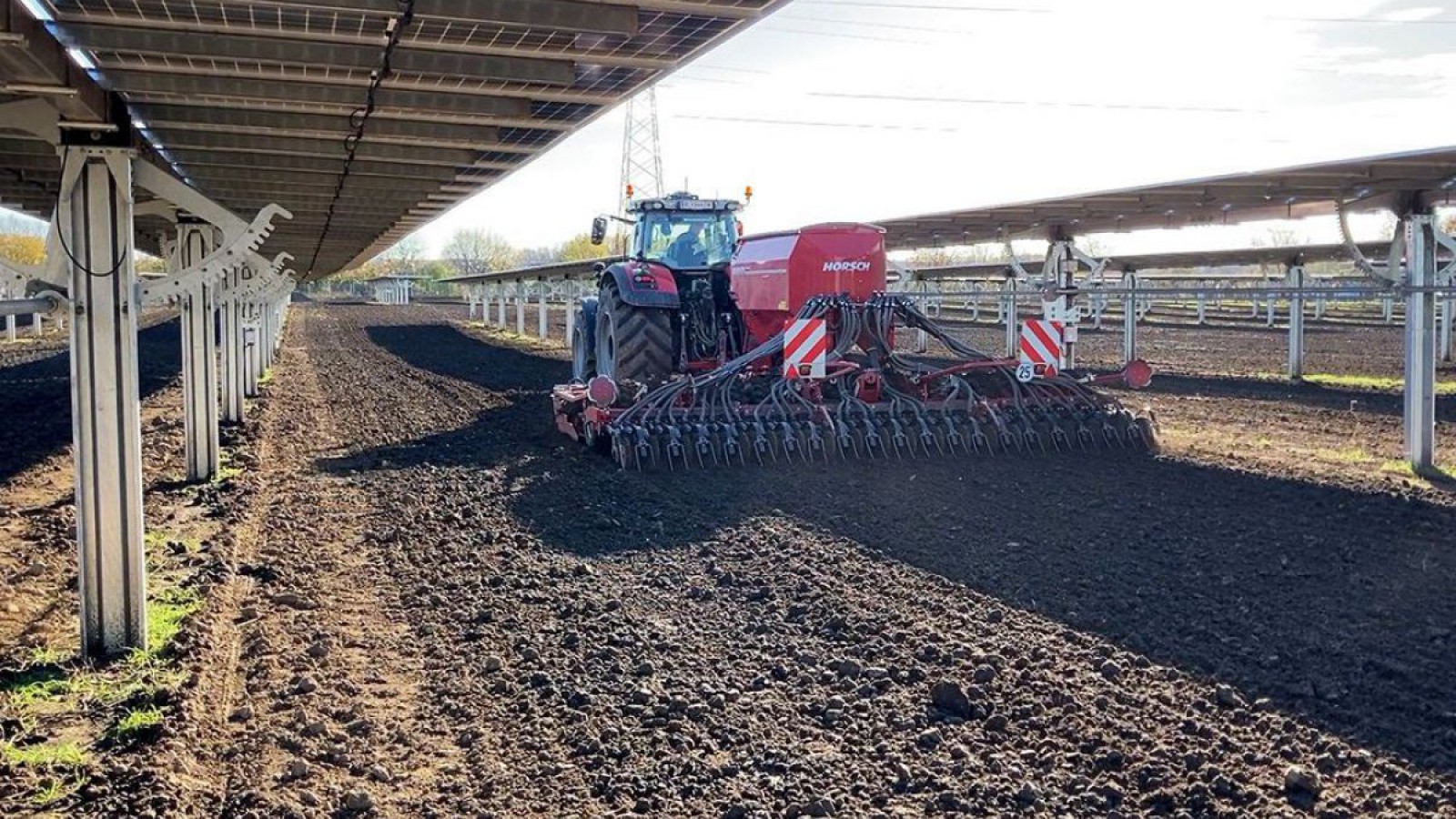
There is a big ass vehicle turning the soil in that pic. I dont think thats a phase of modern agriculture typically presented in the pr photos, and its not pretty even when you do it by hand.
i dont follow, maybe its because im not native english/american? id be happy if you could make the point clearer for me here..cause currently youre discribing the thing but there seems to be no full argument without further context?
Farms are ugly. Factory farms doubly so.
This is the ugly phase. You can see the soil being turned by the tractor in the pic linked. It looks at lesst a little less ugly a couple months after that.
I mean u can easily replace the farming method under it...?!
Never made my point for a farming method here, u can just swap this solar system with syntropic agriculture or whatever your heart desires.... no?
Thats not the point. I... Nevermind.
Goats under economic interest are ugly, I have no clue what your point is by critiquing the solar panel system for a (variable) farming method
I mean we can agree here then no?
Pls enlighten me
No, thanks.
even for non-vegan people the climate impact of sheep farming should be concerning.
interestingly enough - planetary boundries include more essential parameters than greenhouse gases if people would be interested in more food for thought.
like degradation of soil to a level of unusable (N- & P-cycles) due to 75% of landuse for animal food ( "Joseph Poore and Thomas Nemecek (2018)" where sheep are "just" a small percentile since we breed thousand of millions of other human-made animal breeds) or usable freshwater supplies getting more and more critical decade after decade..
this post to be fair was about where to put solar panels
Some combos are beneficial for the plants bellow. Either way, any solar plant is better than coal.
or both! ill wear a solar panel on my head if it helps adoption
You:

Akshualy, covering your fields (partially) with solar increases crop yield by up to 20%. And also feeds your tractor environmentally friendly.
Why not both?
From the agricultural perspective- we’ve got billions to feed and that isn’t going to go away. Better ways to use the land we’ve turned into fields is a different subject, but between plant’s need for solar and how they’re harvested it’s a no go. Wind capture is an option though.
For what’s left of our wild spaces- we’ve already fucked so many. Solar may be a lower impact on what remains but there’s millions of acres that have already been converted for our “needs”. We should focus on generating our power in the areas already developed before talking about dropping more manmade structures in the wild.
It’s often mutually beneficial for animals to graze around solar panels. Having them in fields is not inherently wasting the space.
That’s why I referenced plants, not animals. Also, don’t fool yourself. The bulk of your meat is not grazing in a field even if the packaging label makes it look that way. It’s knee deep in shit-mud and shoulder to shoulder with it’s kin in a CAFO or tearing up the native vegetation on the public lands out west.
There are also studies showing certain plants do well too. Also ignoring that a truly massive amount of cropland is being used for ethanol, which is a much less efficient form of energy than solar.
An even greater amount of cropland is being used for animal feed, something ethanol crops double dip in because they use byproduct from that process in feed. Eliminating ethanol and the luxury of cheap meat would go a long way in reclaiming our crop lands.
Animal agriculture, excepting very small symbiotic regenerative practices youve never fucking heard of, ends in any future where we still have humans in a century.
This is not a moral imperative. The future where thats viable is underwater and boiled to a grey lump.
You wouldn't want many carparks in the first place.
True, but if we're not getting rid of them, let's at least make them useful
My suburban shopping centre has space for 2.2MW, it's about 5km from the nearest power substation
But they can only export 30kw into the suburban grid (10kW/phase * 3 phases)
To export the other 2.17MW they would need to run high voltage main lines 5km to the nearest substation
The farm nearest me has 13kW and is right near a main power line
Parking lots are already wasted space—might as well make them useful too.
Or maybe downsize them like crazy and use them for native plants or housing and build infrastructure like trains trams and busses to reduce the dependence on cars
I have explanation, but you will not like it.
Parking lots have been built on cheap. Those who have roofs can't support any added weight, while those who do not have roofs are far away from any serious electrical connection able to give the energy outside.
The whole idea can be done... on new parking lots.
Also - how about instead we build more water-plant power storage? They pump water to the upper reservoir using electricity in the middle of day, and then produce electricity from flowing water at dawn/dusk/night. This would up the demand for electricity when solar panels are overproducing it and push businesses to consider including solar panels in their constructions.
Ones on roofs are easy, a panel can’t weigh more than a car so you lose a few parking spaces on the roof level and bob’s your uncle. The goal is to reduce car usage so it’s fine. And existing ones are too far away to provide electricity? What? They’re literally beside stores which consume power! Yea I don’t like that answer, it’s dumb as hell.
The pumping idea sounds cool, though, and I’m not against it, but dude I’m so tired of “what if we do nothing because we can’t understand the concept of having multiple solutions going at once?”
The benefit of pavement being cheap is it's not terribly expensive to remove or repair bits of it. Cut a square out, drill down with an auger, chuck a sonotube in and pour a footing. Trenching in conduit for power lines doesn't seem like much of a deal breaker either.
I'd also image a parking lot is closer to an electrical connection than a farm field out in the country.
Okay, I give on the first part, but not on the second.
Farms consume quite a lot of electricity actually, and often electrical grid must be enforced more for a farm than for a suburbs.
Why are you talking about farms?
not near electrical infra
Unlike the average field
Pumped storage can only be feasibly used on existing suitable terrain, and we used most of the easy location.
There is not much left, and with cheap battery storage and power to gas you can go way cheaper. Hydro power and storage is not the future.
Not at scale at least. In rustic situations where ut still needs to be pumped from a well, a small water tower filled during peak makes perfect sense
It's really not difficult to dig a trench through an existing parking lot to lay down wire.
This one actually grinds my gears and it is too popular around here:

This keeps them from having to run a weed trimmer around thousands of supports. Weed trimmers are the most annoying and time consuming part of lawn care.
Have grazing animals on natural meadows instead of artificially sown lawn and you'll not only have the trimming taken care of but also support a variety of plant and animal life under your panels. Sheep and bunnies for example are ideal for the job, don't you think RamRabbit :-)
There is a parking lot and what appears to be multi-level parking garage right behind the panels. Ain't nobody putting goats here. The options are: pay to weed trim around thousands of supports on a regular basis or pay to gravel once.
Goats aren't incompatible with urban environments, especially if they're only brought in to graze every month or so.
Goats are however incompativle with many solar deployments because they will climb up on top of the panels and cause trouble for no other reason than they can (goats are lovable assholes like that)
Why is weed trimming around the supports necessary?
To not make your commercial area look dumpy (there is a parking lot and what appears to be a multi-level parking garage right behind the panels). The owner of this commercial area isn't going to spend 6-digits on panels just to allow their 7-digit commercial area to look dumpy.
I mean the one in the field.
Unfortunately they usually do it on farmland around here, when they could easily go the agrivoltaics route. They would only need to raise it a meter or two and let the sheep roam around doing the trimming for them
Depending on location, it would have been cheaper to have those posts raised/reinforced in the first place instead of buying and hauling all that gravel
Dont cover our car parks. Cover our public transit stations.....oh wait. There are none. (USA)
By all means do both! The more solar power the better.
India has been doing it since 2012, and these fuckers are claiming they invented the concept.
"Brandi McKuin, the lead University of California researcher on the project, says dozens of people have told her they had the idea of covering canals with solar panels decades ago."
That's a nightmare to maintain. The electricians would need to get hazard pay for the risk of falling and the risk of drowning.
Cover both
Why not both?
In the UK we're getting a lot of large solar projects approved on farmland, and locals are predictably upset.
But at the same time those people didn't actually support farmers and buy their stuff at a price that meant they would be better off growing crops rather than covering fields in panels.
And 90% of the complaining is oil industry shills, as per usual.
But it makes the beautiful parking lots ugly.
Imagine a parking lot but with shade in the summer and out the rain
Not going to comment on the fields, but car parks for sure. Keeps the car cool on hot days, can pack your shopping away without getting wet on rainy days, keeps snow off, etc.
Very often the fields that those solar panels are covering are land fills or polluted sites that would be unsuitable for any kind of building or agriculture due to contamination. Utility grade solar often seeks out land that is already disturbed and unsuitable for other purposes because it's cheap.
Covering parking lots with solar panels doesn't make them any less horrible, we should all be aiming towards as little wasted space as possible. Which means no parking lots.
Solar has gotten so cheap to install that solar and wind contractors have been going around the farms around where I live and using high pressure sales and political tactics to buy up good farm land that's been farmed for generations by small family farmers to instead setup solar panels. It's been interesting watching the fight and reactions from the sidelines because there's misinformation being thrown around by both the pro- and anti- solar factions (much more by the anti-solar faction of course) but there's no avoiding that they bought out 2 family farms to do a particular solar project near me, so that's two fewer small farms that will probably never return to growing crops
If you're in the US it would be worth talking to your town and town's planning board then. It would be up to the town planning board whether or not that was an acceptable use of that specific land in that specific area. A developer would only buy that land if they knew they would get a build permit. You can attend a meeting and there's usually a time slot for a public input session on the agenda and you can bring that up. If you're not in the US I'm not sure how it works but it might be similar.
These are all farms outside of city limits of course, that way the energy companies can avoid the most local layer of government and just interact with the county/state level.
I'm honestly not sure how I feel about these projects. On one hand I don't want to see fewer small farms, on the other I'm happy to see more solar and wind energy come online, plus if they're looking at setting up solar/wind at the scale of acres upon acres of solar, their only options are either to take up existing farm land (which lets be real, only about 5% of is producing food that we eat) or to mow down all of the trees and natural growth on undeveloped land that folks keep for hunting, thereby taking away space from wildlife
Or allowing a farmer to let land go fallow and the soil to rebuild while still get a paycheck rather than buckling to sell to a suburban developer (and more carparks).
@Viking_Hippie it might become helpful to cover the fields - many crops benefit from shade these days. Higher crop yields PLUS energy harvest. Win Win. Check for Agro-Solar or Agro-PV.
Apparently, covering ~12% of the Australian Outback with solar panels would generate enough electricity to meet 100% of global energy (electricity, heating, transport) needs?!
If that's true, the problem would be storing and transporting it. Sending electricity via wires is massively inefficient and limited in range.
I didn’t propose it as a viable solution, but more-so as a thought experiment or proof of concept.
A proper implementation would be pretty decentralised to minimise transmission loss where possible, and complemented with whatever analogue energy storage system makes sense locally (hydro dams/kinetic/molten salt/lithium/sodium batteries etc.).
Solar is also not always the solution for colder climates, but in those places we can opt for geothermal or wind sources where feasible, otherwise transmit surplus energy from warmer climates as an absolute last resort.
Oh yeah, for sure. I'm all for more solar. I just hope the scientists continue their research and figure out a way to make the panels without quite so much lead. Or at least make sure the lead can't leech back into the environment.
https://en.wikipedia.org/wiki/Perovskite_solar_cell
Funnily enough, I just recently saw a video about Perovskite solar panels: https://m.youtube.com/watch?v=w2r9_0NxTW8
First time learning about them, but they do seemingly like a great solution once they come into maturity over the next decade. At that point, we could be at only needing ~6% of the Outback to power the world!
THAT is how we should do world domination. Want to take over the world? Provide sustainable infrastructure and renewable resources.
Por que no los dos?
If you aren't using the field, who cares? Yeah fields are pretty, but honestly so are solar farms
I don’t know the numbers but Americans grow acres of corn for the sole purpose of making ethanol. I think they can spare a few acres for a far better solution.
@Viking_Hippie But since we will remove all individual cars, there won’t be any car parks on which to build…
Got 'em. We should wait until we get rid of all the cars before we start putting up solar panels. One thing at a time people!
I live in tbe tropics, and in the new shopping centre they built modeld off of one from a different climate they put shade cloth over the car parks so it's not dry in the rain.
Then when we have cyclones it just gets ripped apart each year.
Really should be solid roof and solar panels.
Our hospital even has snow covers over the windows despite the weather never dropping below 15 degrees c and has never snowed because they copied another southern building
No, parking lots need to be developed. We can't have functional cities when every other plot of land is dedicated to park cars.
I would like them on our sidewalks. Obviously, trees would be better but if we aren't gonna plant trees, then at least provide us shade with solar panels, please.
Our fields are growing corn to burn as biofuel which delivers much less energy than a solar panel
Remove the car parks in the first place
Yeah, that's never going to happen. Might as well try to make the best of it.
Never gonna happen with that defeatist attitude, no
counterpoint - get rid of car parks and cars
i know the los dos is old but seriously why not integrate them into fencing. keep enough for electric and the rest goes toward paying for the fence. then some crops need shade so thats a good time to use it. lets not forget roofs in general.
That would make too much sense.
Ever since I was a kid, I used to wonder why roofs of buildings didn't include, or where made of, solar panels.
interesting concept. i think it would be cool if we had solar power cars so we wouldn't put so much pollution in the environment. but i don't think the tech is there yet and if it was big oil won't let it happen.
I mean, functionally we do have the tech, but it's just solar farms powering the grid/on rooftop, powering an electric car. Probably more efficient than putting the panel on the car anyways.
My biggest problem with this is that the shading doesn't cover the road between the parking spaces. In my experience that just means during early or later in the day you may as well not have the shading, at least hang up some canvas shaders or something.
It still helps. I tinted my car. It still gets hot inside, but I did eventually hop between two cars (one untinted) and was able to actually feel a difference. All hots are hot, but some hots are hotter than others. Humans aren't good at telling hots apart and it takes a lot of testing to get reliable data by thermometer to account for weather.
That being said, I'm pretty sure the image is generated. The closest suv seems to be eating the compact in front. The next solar array spot is 75% as deep with half spaces on the far row.
And then turn parkings into essential energy infrastructure? Nah. Buldose the parking, put some houses, and put solar panels on the houses
It's the top photo AI? You aren't supposed to put panels on flammable material like that.
Which here is the flammable material?
Dried grass.
The grass won't go dry under these panels if mowed regularly
Mowed regularly beneath the shallow panels themselves?
You won't believe what I'm about to show you
spoiler

I actually cannot believe it, they are so small! How the hell do they store cut grass?
Since the labor cost to run them is minimal, they can be run daily and produce tiny clippings that remain on the turf as mulch.
I'd assume they're mulching mowers.
Just looked them up. That's pretty cool! It basically atomizes the grass and uses it as an in-place fertilizer?
Yep I had one a long time ago, it was way more convenient than dealing with bags or just having clippings everywhere
Remote control carting course it is then
@Viking_Hippie Or both? Solar panels can be good for crops, pollinators and wildlife.
https://theconversation.com/win-win-how-solar-farms-can-double-as-havens-for-our-wildlife-194920
They can coexist pretty well with animal farming. The animals use them for shelter..
But yeah, absolutely on car parks (or better, get rid of car parks)
@Viking_Hippie actually agrivoltaics work pretty well and help farming :)
@Viking_Hippie certainly cover car parks *first*....
Don't put them over car parks, put them anywhere and everywhere. It's far more expensive to build both roofs and solar panels.
The field in question is probably being used to crow ethanol so replacing it with solar panels is an improvement if anything.
Carport solar is a terrible idea.
-
Increased height for structure, likely increased weight as well since you need to make super-duper sure they don't pancake somebody's car. This leads to;
-
MUCH greater chance of property damage and resulting payouts (not to mention the risk of somebody's Timmy managing to shock themselves)
-
Harder to build and maintain due to number 1, as well as having a bunch of cars around, needing to schedule lot closures, etc.
-
Number 3 gets in the way of actually using the parking lot as a parking lot, which is probably going to be pretty unpopular with the property owner and/or lose them money from decreased business.
-
Oh yah, harder to angle due to the constraints you're under, so less efficient.
All this adds up to making it a lot more expensive than just putting them on the ground. We have TONS of abandoned malls and supermarkets all over the country, just use that smh.
What insanity is this, have you ever been in a parking garage where most are like 8ft ceilings. Most solar car parks are well over 12ft and no issue with building them. Yeah it's more expensive to build solar car ports vs ground based but you don't need to build big transmission lines which delay or prevent many large solar fields. Then hopefully you can have EV charging stations right there power cars off the sun.
-
It's either a roof structure by itself or adds another ~3cm of height to an existing roof.
-
You vastly overestimate the weight of solar panels. The ones shown probably weigh ~20kg, and probably ~35kg with framing etc. Most car roofs are rated to 30-150kg of dynamic weight. In the statistically highly improbable event where the structure completely collapsed it certainly will not "pancake" anything and will likely just be cosmetic damage.
"somebody's Timmy managing to shock themselves"
No more dangerous than any of the wires that are, probably, within a few meters of you as you read this.
-
"Harder to build and maintain" sure, but not by much and nothing requiring the full lot closures you're imagining.
-
"harder to angle" Sort of, there might be instances where a suboptimal angle results in better aesthetics, cheaper materials, snow clearing, etc. but we're talking ~10-15% efficiency loss.
Based on the shoddy logic and non-existent research I'm guessing this isn't really about the solar panels. You wanna share what the deeper concern/peeve is?
My concern is people advocating for expensive and ineffectual strategies because it looks cool in a social media post instead of doing things that are actually useful. We have an insane amount of land to use. Do public transit, do utility-scale solar. Don't do this nonsense.
Oof, I 100% feel you there. That is a huge problem and those 2 suggestions are critical things that need to be done more of. I'm 100% with you that pretending like these dinky little instillations are at the scale of what is needed is ridiculous.
However. I do think your overall frustration is coloring your perception of this solution a bit. I think you would be shocked at the efficiency possible from a distributed solar network like this.
Yes, a centralized utility scale solar in the "insane amount of usable land" is more efficient both resource-wise due to economies of scale and in generation due to things like sun-tracking. However, it has significantly more transmission losses and labor upkeep.
A distributed solar network's goal is to reduce those transmission losses by having the generation at point of load and increase local independence/resiliency at the cost of some resource and generation efficiency. It is solving a slightly different problem and so has different weighting on the cost/benefit analysis.
Understanding more where you're coming from; I get it. But projecting that frustration onto decent solutions to different problems in such a factually incorrect way is not helping.
i remember when i was five on the top floor of a parking garage i touched the solar roof on my great-great granpappy's fisker karma and got a nasty shock. Shocked the gay right out of me. But then i touched some exposed wiring on one of the tall lampposts and that turned me Bi so who's laughin now gramps
coincidentally, the lamppost then also fell into his car, and he renounced his commitment to the environment and bought a Hummer h2 with his fat insurance payout
Where is the country?
Can we stop this shit