Linux Rules
2d 6h ago by lemmy.blahaj.zone/u/SnotFlickerman in onehundredninetysix@lemmy.blahaj.zone from lemmy.blahaj.zone
Shamelessly stolen from you know where
> "Linux never succeeded."
> Almost all Supercomputers run Linux.
> Most Web Servers Run Linux
> Is the basis for Android
lol wat
Also:
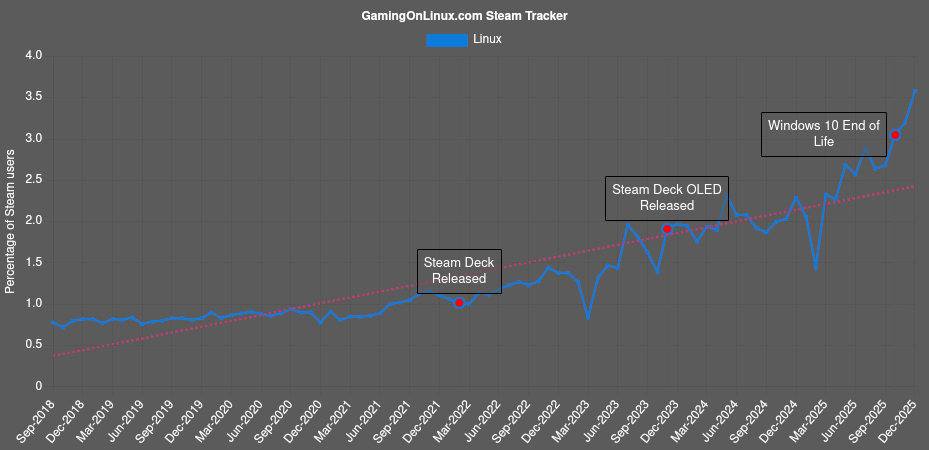
At this rate steam on linux will hit like 10% in a few years.
The general desktop marketshare of linux is slightly higher than the steam. Its at like 4.5% already
One other factor that also influences Linux' market share is that a lot of people just don't use PCs anymore and rely only on smartphones. I assume that Linux users are less likely to stop using PCs completely than Windows Users are (or rather, that people who don't even get into PCs would have been less likely to become Linux users if they did)
So it's not just direct conversion from Windows to Linux, but also a higher retention of users somewhat.
Exactly. People are talking about jumping ship from Windows to Linux after the recent update while regular people have moved to phones 10 years ago
Sorry, Windows still dominates the computer OS market.
Except for computers that are small, computers that are large, computers that are very fast, computers that are resource-limited, computers most used by normal people (mobile) and computers most used by enterprises (server VMs).
But desktop computers that are used to launch MS Office or games, boy does Microsoft still dominate that market.
You had me triggered in the first sentence but I came around, haha
Same, ngl
I'm hearing that Windows is good for exceptionally medium workloads. Is Windows the Cincinnati of computing?
Most corporate servers in general run Linux, let alone webservers. Intel literally used Minix without attribution in their Intel Management Engine, so technically every Intel chipset motherboard with an IME runs Linux. That's basically every Intel motherboard since 2008.
Minix is a different (older) kernel from Linux: https://www.minix3.org/
Minix isn't linux although it's a character in Super TUX Kart
Linux already won. Only people who don't use it are losing.
I am reminded of that one time we went to lunch with one of our scrum masters and he actually said "why does linux even still exist anymore".
I didn't even get into all of that i just told him i switched my home pc to linux a few months ago lol
scrum master
Remind me to kill myself if anyone ever gives me this as an official title
more like cum master, amarite??
i am so sorry. please forgive me ;w;
that's a much better title, I'd wear that with pride. don't belittle cum by comparing it to that garbage.
Most complex life on earth owes its existence to cum in some form or another!
> I run linux (slackware ftw!)
> praise Bob
I know Lovense Lush uses a Nordic nRF51822 microcontroller, this doesn't run a full OS normally. It runs ARM machine code directly, usually programmed in a C variant in something like Keil. They provide an SDK with an Arduino compatible platform, so it might even just run Arduino. No idea if someone analysed the software on those microcontrollers as it's pretty niche and the code inside is probably super simple. The microcontroller is way overpowered for what it does, but it isn't that overpowered that it could run a full Linux stack.
Are you like an open buttplug dev or somwthing?
https://buttplug.io/
Yes that's what I meant
qDot is one
..I think I've found a new project for the weekend
Yes I think I saw the episode over Brody Robertsons Podcast tech over tea. It seems like a fun project to have
Thank you for this comment.
I really needed that laugh
Have a nice day :3 or something
You as well!
Working hard to bring PornHub and GitHub together!
Idk what that means butt have fun ig :3
GitPorn.
https://ossm.tech/
I remember watching a talk about sex toy hacking once, I'll try to find it for your (and everyone else's) pleasure. Think it was a Lovense in that talk
smea - Adventures In Smart Buttplug Penetration testing - DEF CON 27 Conference
https://www.youtube.com/watch?v=RnxcPeemHSc
Been a while since I watched that, should probably rewatch it soon
Unless the vibrator needs to be wireless that nrf is way overpowered and expensive. For mass production you want the cheapest, smallest, thing that will do the job.
Yes the Lovense Lush is the most popular wireless vibrator. It can be controlled over Bluetooth by an app or computer. It is used a lot in livestreams where viewers can donate to make the vibrator vibrate in a certain pattern and duration. There is a whole software ecosystem around these where the streaming platform handles the payments and integrates with the local software controlling the vibrator. I choose that vibrator specifically as an example, because it probably has one of the most powerful chips inside and the most functionality.
What you said is accurate but it implied systems with an OS don't run machine code directly. They still do, just the CPU has ways of automatically interacting with the OS when it needs to (and those features are enabled), mostly via interrupt handlers. Things like address translation happens transparently, either via a lookup table for recently used addresses or the CPU will throw a TLB miss interrupt if it's not ready to go and needs the OS to give it a mapping (or maybe even load the page from disk before it can proceed).
CPU architecture is pretty interesting and doesn't require programs run through a translation layer like Java, Python, or JavaScript. The translation layers themselves are programs running as machine code at the user level.
Edit: I see now that you meant the directly as in the microcontroller runs the ARM uarch. I'll leave this up in case anyone reads it like I did initially, but sorry for the misunderstanding on my end.
Not even the more expensive microcontrollers run Linux.
The kind of thing you would see in such a simple device like a dildo are the cheaper smaller ones with RAM sizes and Flash Memory sizes in the KB range and costs less that $1 in bulk.
Mind you, you can squeeze a Linux kernel into a really small amount of memory, but why for a production device pay more for a larger than needed microcontroller and then use most of its storage for a Linux kernel leaving little space for the actual functional code when you don't need support for things like filesystems or networking?
Microcontrollers are a whole different world from microprocessors.
Not even the more expensive microcontrollers run Linux.
Linux on microcontrollers was a thing back in 1998.
More modern and capable microcontrollers like the fairly cheap ESP32 can run linux pretty well.
You can force it to happen (because the Linux kernel is quite modular and you can make it way smaller by switching off a lot of things) but as I said, what's the point when all you need is to literally run a single application that only toggles I/O ports or does a bit of comms with an external integrated circuit via I2C, Serial or SPI?
In a production design for something as simple as a dildo - so basically a motor controller - there really is no point in paying for a more powerful and more expensive microcontroller, adding cost to the final product, just to stuff a Linux kernel there to run a single application that doesn't need things like filesystem or networking support.
(For example, here is an example of about the most low end microcontroller you can use. Notice the 128 bytes of RAM and 2KB Flash storage. You can stuff enough code in there to activate a motor in one of several specific simple cycles depending on the position of a switch but not much more. Of course that kind of stuff is programmed in C either directly on top of the hardware - by literally changing microcontroller registers - or most likely on top of a manufacturer specific low level library)
Further if you do need functionalities of an OS such as multiple task/application support, there are alternatives that tend to be better for those kinds of use, such as various RTOSes.
Now, as many pointed out, there's plenty of reason to do it for the challenge or the fun of it - the ethos of any good hacker in the traditional sense of the word - just not for a production design of a device for which tens/hundreds of thousands of units will be made where adding Linux raises the needed capabilities of the microcontroller and hence the hardware cost while not actually helping to deliver the needed functionality.
what’s the point when all you need is to literally run a single application that only toggles I/O ports or does a bit of comms with an external integrated circuit via I2C, Serial or SPI?
None, but sometimes you need far more functionality. A micro-controller is cheaper and less power hungry than a full fledged SOC, which is why you find them in things like e-ink tablets.
I'm not saying it's common, but given the swath of "high end" internet connected adult toys I wouldn't be shocked if there's a handful running linux.
While you were probably fully correct in the past, with how they are forcing everything to be "smart" now, it is entirely possible that everything from vibrators, to toasters, to refrigerators could be running Linux on a cheap chipset.
In my experience, pretty much everything does indeed have a microcontroller nowadays (because software is so much easier to make, test and change than electronics, plus a lot of what took several digital components in the old days are just a few lines of code in a microcontroller, so putting a microcontroller there is cheaper also in hardware terms), but most things use tiny ones like the one whose info I linked in my previous post (if you get your hands on a broken mouse, open it up and google the part codes of the integrated circuits you find inside), with maybe a bit more memory since that specific ATTiny is very much on the lower end.
The reason why it's something like that rather than something bigger, is that something like that costs $0.38 each, in bulk, whilst something that's big enough to run Linux costs around $10+, plus something like that has a smaller physical footprint, needs all of 1 capacitor and 1 resistor externally for it to work and can work directly from some pretty shit power sources, further reducing overall costs, whilst microprocessors demand a lot more supporting electronics and proper power regulation to work.
When the cost of putting a big one there are nothing next to the overall device costs, manufacturers can easilly just upgrade it to "smart" enough to justify Linux (which goes beyond merelly digital controllers and displays or even WiFi connectivity and into Android TV levels of complexity) with little risk, but when we are talking about much cheaper stuff, they'll only make a "smart" version if there's explicity demand for such "smarts" that's willing to play a lot more. Notice how, when comes to dildos if you look at the Lovense which probably the most complex around, as somebody else pointed out it still uses a microcontroller that's not running Linux and is way too small for having Linux to be worth it even if possible - in fact per its datasheet doesn't even support WiFi but only Bluetooth LE, which means it doesn't even have an IP stack, as Bluetooth is basically Serial-over-radio, which means it's actually the software on the other side of that Bluetooth link that does the heavy lifting.
I think your idea of "everything" in Electronics is pretty much just big ticket Consumer Electronics, yet most Electronics out there by number of units is actually the small stuff that costs a few dollars in parts to make, and almost all dildos fall into the second category, not the first.
You are correct on most things here, but your example pricing is WAY off. You can get Linux capable microcontrollers for less than two dollars retail, and most certainly much cheaper in bulk. I want to be clear that I in no way support putting this sort of tech into these devices. I do think that with the current trend of wanting to add "AI" to consumer devices and/or siphon up as much user information as possible, inexpensive embedded Linux being very common wouldn't shock me at all.
Can you give me an example of a microcontroller that can run Linux in production (so, not just be made to run Linux experimentally, but which actually is used in applications were it's worth it to run Linux on it) AND which costs less than $2 in bulk?
Because the only ones I can think of, the lower end of the Esp32 range, can run Linux but it's just not worth it for the kind of applications they end up in.
The esp32-s3 is specifically one I was thinking of, its less then $2 for purchasing a single chip. You keep moving goal posts here, so I'll just leave it. Have a good one.
"Moving goalposts" is asking you to back your claims versus the point I was making in the posts you replied to (which include the whole "in production" part)?!
Sure, mate, salve your ego after having blindly dived into deeper waters than you expected.
For the lolz probably. There doesn't have to be a rational reason for everything..
It's very slow, but some people made a RISC-V rv32ima emulator that runs on an ATMega328P to run Linux on an Arduino Uno. Nobody would do that in a commercial product (it's ridiculously slow, difficult, and further into "for shits & giggles" than Taco bell with laughing gas), but even the cheap shitty microcontrollers can run Linux. Badly.
Yeah, Linux is till amazingly modular and it's a fun advanced hobbyist project to just get it to run in the smallest thing possible ("Linux in a potato").
It's not however logical to increase hardware requirements (and hence costs) in the design of a production device just to have Linux there when all you're running is a single task in a single thread to control a motor, something you can otherwise probably fit in something like this.
Most simple consumer electronics run C
Probably the web api enabled ones though
eh not really, i've run a (really simple) web server on esp32 before
The only experience I have with those (I'm an EE but don't practice it professionally so have only have done embedded circuits for fun) is things like the ESP8266 and ESP32 and those come with an RTOS, though at least the latter should be powerful enough to fit Linux. You can actually program for those in C on top of Arduino or on top of the manufacturer libraries which are a bit more high level than for simpler microcontrollers without WiFi support as they come with an IP stack rather than only exposing low level hardware functionality.
(It is actually a lot of fun making a proper web application on one of those to allow remote control of some hardware from an Android app - if you make it a REST interface - or even from a browser - if you make it serve web pages. I believe most "controllable from your mobile phone" lights out there use one of these microcontrollers or similar on the lamp side).
The Nordic nRF51822 somebody else mentioned doesn't even have WiFi support, only Bluetooth LE and has less memory.
The microcontroller probably runs Zephyr, not Linux. It's fine, Zephyr is also sponsored by Linux Foundation.
Probably some SDK-powered bare metal, don't think an RTOS is needed for a vibrator (and certainly not a feature-packed one like zephyr). Could be, though
Depends on the features. Just an imbalanced motors, battery holder, and a switch could be enough. Anything else is extra.
Linux succeeded where his dad couldn’t
His "dad".
That’s it, shut everything down. This is the comment that wins.
“Linux never succeeded” is such a funny take when it’s quietly running most servers, phones (Android), and a ton of embedded stuff. The real Linux rule is: if it works, nobody notices 😄
Hopefully not, the only reason it would need linux is if it connected to wifi and I don't know who wants that.
Anything up to bluetooth should work with just a Microcontroller running nothing more complex that a small rtos.
is if it connected to wifi and I don't know who wants that.
Lots of folks enjoy playing with their partner remotely.
Now wait for the "Approaching orgam detected. Subscribe for $5.99/month or continue with ad-supported orgasm-free experience."
Teledildonics
Smart sex toys exist
Best "Yo Mama" comeback ever.
the app is lit cat /dev/zero > /dev/null
Is this the right place for an "Of course it can run NetBSD" comment?
For running a vibrator, you'd probably can do with an ESP32 or RPi2040. No need for the big guns (pun intended).
A vibrator will use an epoxy blob chip, ESP32 is overkill
Depends. Most of those epoxy blob coffee machine controllers don't do Wifi or BT.
Linux is a distant third in a three horse race.
If the only race track you consider is "personal desktop computer usage" then sure.